

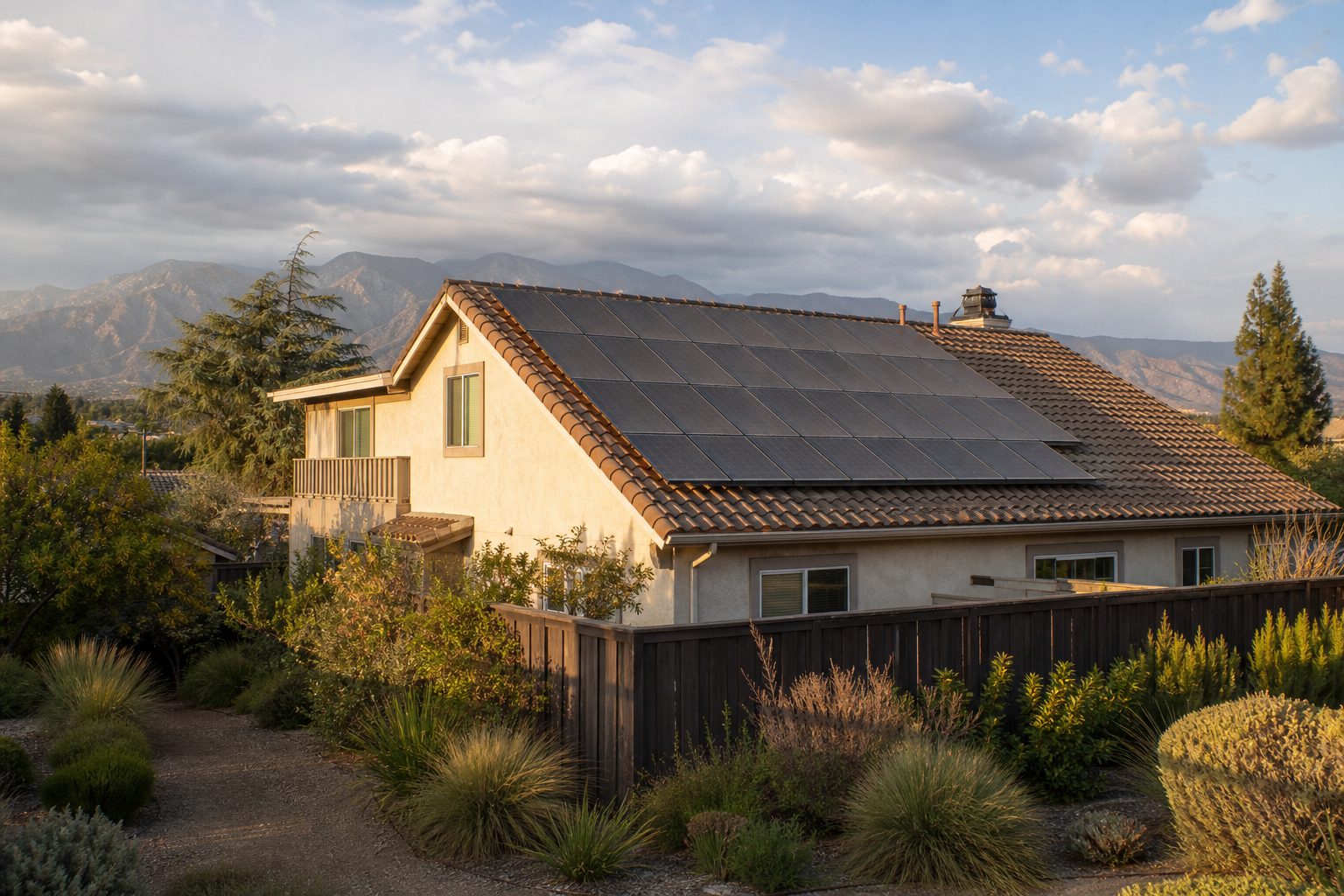
Is solar still worth it in Rancho Cucamonga now that the federal tax credit has ended?
For many homeowners, yes. But the math changed significantly, and getting it right matters more than ever, especially when you sell.
On July 4, 2025, the One Big Beautiful Bill Act was signed into law, ending the Section 25D federal solar tax credit for homeowner-purchased systems after December 31, 2025. At the same time, California’s NEM 3.0 (Net Billing Tariff) has slashed what Southern California Edison pays you for power you send back to the grid. Today, solar works best with a battery, a properly sized system, and realistic expectations about payback. And if you’re thinking about selling your Rancho Cucamonga home, how your solar is set up, owned, leased, or grandfathered under NEM 2.0, can meaningfully affect your sale.
If you’re considering listing your home or just want to understand what your solar setup adds to your property’s value, the first step is getting a proper valuation that accounts for it. Reach out to us at Sold By Blay to find out what your home is really worth.
*This article is general information, not tax, legal, or financial advice. Confirm incentives and rates with SCE, a tax professional, and multiple licensed installers. Rates, incentives, and rules are current as of September 2026; solar policy changes frequently.*
—
Why This Matters Right Now in Rancho Cucamonga
We get asked about solar constantly, and in 2026, the conversation is completely different from what it was two years ago. Rancho Cucamonga homeowners face some of the highest utility bills in the state because of our hot summers. SCE rates in the mid-30-cent-per-kWh range, combined with air conditioning running from May through October, mean energy costs here are real. Utility bills in Rancho Cucamonga run well above national averages (the local utility cost index sits at roughly 149, per cost-of-living data).
At the same time, solar panels have never been cheaper per watt. So even without the federal credit, the economics can still work. But you need to understand the new rules, and if you’re selling, you need to know how solar affects your transaction. That is exactly what we are going to break down.
—
What Changed: The Tax Credit and NEM 3.0 in Plain English
The End of the 30% Federal Credit
The solar tax credit has several sections depending on who claims it. Section 25D was the version for homeowners who purchase their systems with cash or a loan. The One Big Beautiful Bill Act amended that credit to expire for expenditures made after December 31, 2025. There was no phase-down. It simply ended.
On a $25,000 system, that credit was worth $7,500. That money is no longer available for purchased systems in 2026.
What about leases and PPAs? The business-claimed 48E tax credit for residential solar leases, PPAs, and prepaid solar products remains in effect through the end of 2027, according to the current legislation. Businesses and third-party system owners can still access a separate credit under Section 48E, though it now comes with new sourcing and construction timing rules. Some lease and PPA providers pass a portion of that savings through to homeowners in the form of lower monthly payments. Ask any provider directly whether they do this and how much.
NEM 3.0: What SCE Now Pays for Your Extra Power
Rancho Cucamonga is served by Southern California Edison, which means NEM 3.0 (SCE calls it the Solar Billing Plan) governs every solar system with a new interconnection application after April 14, 2023. Here is the core issue:
- Export credits fell roughly 75%, from about $0.30 per kWh under NEM 2.0 (near retail) to an average of about $0.05 to $0.08 per kWh under NEM 3.0, according to the California Public Utilities Commission’s Avoided Cost Calculator
- The power you import still costs $0.30 to $0.55 per kWh at peak, depending on your SCE time-of-use plan and season
- If you over-produce for the year, you do not get paid for the excess. It is lost. This is one of the most misunderstood details under NEM 3.0
The single most valuable kilowatt-hour is the one your panels make and your home uses at the same moment. It never touches the grid, so it offsets a full retail-priced import directly. Under NEM 3.0, the game shifts from “send everything to the grid” to “use your own power when you make it.”
—
Buy, Finance, or Lease Solar in Rancho Cucamonga in 2026?
Here is a straightforward comparison to help you think through your options:
Cash Purchase
- Upfront cost: High ($15K to $35K+)
- Federal credit: None (25D ended)
- Ownership: You own it outright
- Maintenance: Your responsibility
- When you sell: Adds equity and transfers cleanly with no complications
Loan or Financed Purchase
- Upfront cost: $0 down, monthly payment
- Federal credit: None (25D ended)
- Ownership: You own it after payoff
- Maintenance: Your responsibility
- When you sell: Any lien (PACE or UCC) must be addressed at closing; check your loan documents carefully
Lease or PPA
- Upfront cost: $0 down
- Federal credit: Stays with the leasing company (48E may apply through 2027)
- Ownership: Leasing company owns the system
- Maintenance: Covered by the lessor
- When you sell: The buyer must qualify and assume the lease, which can add time in escrow
What does this actually mean for your sale? If you own the system outright, it is the cleanest scenario. It transfers with the property, and buyers see it as a feature. A leased system is manageable, but the buyer has to qualify for the lease transfer, and that extra step can slow things down, especially in a market where homes in Rancho Cucamonga are already taking a median of 25 to 26 days to sell, according to recent market data.
—
Why Batteries Now Matter Most in Rancho Cucamonga
Under NEM 3.0, a battery is no longer a luxury add-on. It is the central piece of the economic case for solar.
SCE’s residential time-of-use plans price power highest from 4 to 9 PM, exactly when your panels wind down. A battery stores your midday excess instead of exporting it at those low avoided-cost rates, then discharges during the expensive evening TOU hours. You are offsetting full retail rates instead of collecting pennies.
In Rancho Cucamonga specifically, batteries do double duty. Our Santa Ana wind events and SCE Public Safety Power Shutoffs can knock out power for hours or days. The January 2025 windstorm that hit our area was severe enough to trigger a state of emergency declaration for the city in December 2025. And with the statewide El Nino emergency proclaimed September 21, 2026, storm preparedness is not theoretical. Storm preparedness is especially important for homeowners in foothill communities—check out our Etiwanda community guide for more on how weather and location shape energy needs in our area.
The California Self-Generation Incentive Program (SGIP) may still offer battery rebates for SCE customers. One source cites approximately $2,025 for a typical 13.5 kWh battery, though availability and amounts should be confirmed directly with SCE and your installer before committing.
—
Solar in Winter: What Rancho Cucamonga Homeowners Should Know
You might think winter makes solar pointless, but it is more nuanced than that. Yes, shorter days mean lower production. A typical Southern California system produces noticeably less in December than in June. But your cooling costs also drop dramatically, which means your overall energy demand falls too.
SCE uses an annual true-up cycle, which means your summer overproduction can offset winter shortfalls across the full year. Winter SCE rates are also generally lower than summer peak rates, so the seasonal swing is built into the billing structure.
Here is the smart play: winter is actually an excellent time to plan a solar installation. Get quotes, pull permits, and complete your interconnection paperwork during the slower months so your system is running before the summer heat hits and those high cooling bills start rolling in. Typical permitting and installation timelines in our area can stretch several weeks, so starting in late fall or early winter positions you perfectly.
Storm preparedness also matters. If you already have solar, have your installer inspect your racking to ensure it is rated for our wind conditions. Clear dust and debris from panels after Santa Ana events, but do it safely or hire a professional. For a full rundown on Rancho Cucamonga storm prep and living in our area, explore our Rancho Cucamonga housing market and climate guide.
—
The Real Numbers: Costs and Payback Ranges in the Inland Empire
We are going to be honest here because the ranges vary widely depending on the source. Here is what the data shows for SCE territory as of 2026:
- Typical residential solar system cost: Varies by size, but ranges commonly cited are between $2.50 and $4.00+ per watt before any incentives, depending on equipment, installer, and system complexity
- Battery cost: A typical 13.5 kWh battery adds significant cost to the system; exact pricing varies by brand and installation
- Payback for solar-only under NEM 3.0: Roughly 9 to 14 years, depending on usage, system size, shading, and rate plan
- Payback for solar-plus-battery: Roughly 6 to 10 years, because the battery lets you avoid expensive peak-hour imports
What shortens your payback? High electricity usage, an EV you charge at home, a pool, or heavy evening consumption. What lengthens it? Low usage, significant shading from trees or structures, or a roof that needs replacement before panels go up.
For Rancho Cucamonga specifically, our strong sun exposure and high summer cooling demand put most homeowners on the favorable end of these ranges, especially in foothill communities like Etiwanda, where larger luxury homes mean larger energy bills.
—
Selling a Rancho Cucamonga Home With Solar: Owned, Leased, or NEM 2.0
This is where we bring the real estate perspective, and it is the section that matters most if you are thinking about listing.
Owned Solar Adds Real Value
When you own the system outright, it transfers with the property and buyers see lower utility bills as a genuine feature. Research from the Lawrence Berkeley National Laboratory has found that solar can increase home value, though the exact premium varies by market and system age. In a city where median home values range from roughly $645,000 to $826,000 depending on the source and time period, according to multiple market data providers as of mid-2026, any additional value matters.
Leased Solar Requires Extra Steps
If your system is leased, the buyer must qualify for and agree to assume the lease. This is not a dealbreaker, but it adds a step during escrow. We always recommend gathering these documents before listing: the lease agreement, transfer requirements, monthly payment history, and production data.
NEM 2.0 Grandfathering Is a Selling Point
If your system was interconnected before April 14, 2023, you are grandfathered under NEM 2.0 for 20 years from your original interconnection date. Those favorable export rates transfer to the new owner when the home sells. This is a genuine competitive advantage, and we make sure to market it accordingly. If you are curious how to position this when selling, check out our pre-listing documentation guide for property-specific details.
Documents to Gather Before Listing
- Ownership proof or lease agreement
- SCE interconnection agreement showing NEM version
- Production history (most monitoring apps export this)
- Warranty information and remaining term
- Battery documentation if applicable
- Any PACE or UCC lien details from your loan
Want to know what your home, solar included, is worth in today’s market? Contact us at Sold By Blay for a valuation that properly accounts for your system. You can reach us at 909-641-8751 or through soldbyblay.com.
—
Buying a Rancho Cucamonga Home With Solar: Questions to Ask
If you are on the buying side, you need to ask the right questions before making an offer on a home with solar:
- Is the system owned, leased, or financed? This determines whether it transfers cleanly or requires additional qualification
- Is the system on NEM 2.0 or NEM 3.0? NEM 2.0 grandfathered systems are significantly more valuable
- How old is the system, and what warranty remains? Panels degrade slowly, but inverters typically need replacement sooner
- Is there a battery? Under NEM 3.0, a system without a battery delivers much less savings
- What is the roof age under the panels? Removing and reinstalling panels for a roof replacement is expensive
- Are there any liens? Check for PACE assessments or UCC filings tied to solar financing
- Can the seller provide production data? Monitoring apps can show actual monthly output versus what was promised
If you are searching for homes with solar or new construction (which includes solar under California’s Title 24 requirements) in Rancho Cucamonga, our community guides and neighborhood profiles on soldbyblay.com offer detailed insights into local market trends. New communities like Vinova and other developments in our area come with solar standard, but how those systems are structured varies.
—
Is Solar Worth It for You? A Quick Checklist for Rancho Cucamonga Homeowners
Not everyone’s situation is the same. Here is a quick way to assess whether solar makes sense for you right now:
- Your monthly SCE bill is consistently high, especially in summer. The higher your bill, the faster the payback
- You plan to stay in your home for at least 7 to 10 years, giving the system time to pay for itself without the federal credit
- Your roof is in good condition and does not need replacement in the next 5 to 10 years
- Your roof faces south or west with minimal shading from trees, neighboring structures, or foothill terrain
- You are interested in backup power during SCE outages and PSPS events
- You have or plan to get an electric vehicle, which significantly increases your electricity consumption
- You are not planning to sell in the next 1 to 2 years. If you are listing soon, installing solar now may not recoup the cost at sale. Instead, focus on documenting any existing system properly
If you are planning to sell, the more important question is not whether to install solar but how to maximize the value of the solar you already have. That is exactly what we help our clients navigate.
—
Frequently Asked Questions About Solar in Rancho Cucamonga
Is solar still worth it in California under NEM 3.0?
For most homeowners with moderate to high electricity usage, yes. The key difference is that NEM 3.0 rewards self-consumption (using your own power) rather than exporting to the grid. Pairing solar with a battery dramatically improves the economics because you store cheap daytime power and use it during expensive evening hours. Without a battery, payback timelines stretch to roughly 9 to 14 years. With one, the range tightens to roughly 6 to 10 years.
Is there still a federal solar tax credit in 2026?
No, not for homeowners who purchase their systems. The Section 25D Residential Clean Energy Credit ended for expenditures made after December 31, 2025, under the One Big Beautiful Bill Act signed July 4, 2025. There was no phase-down period. Third-party-owned systems (leases and PPAs) may still benefit from the separate Section 48E commercial credit through the end of 2027.
Can I still get a tax credit if I lease solar in Rancho Cucamonga?
You personally do not claim the credit, but the leasing company may be able to use the Section 48E credit, and some providers pass part of that value through to you in the form of lower monthly payments. Ask the provider directly. This is an important question to ask before signing any lease or PPA agreement in 2026.

Leave a Reply