


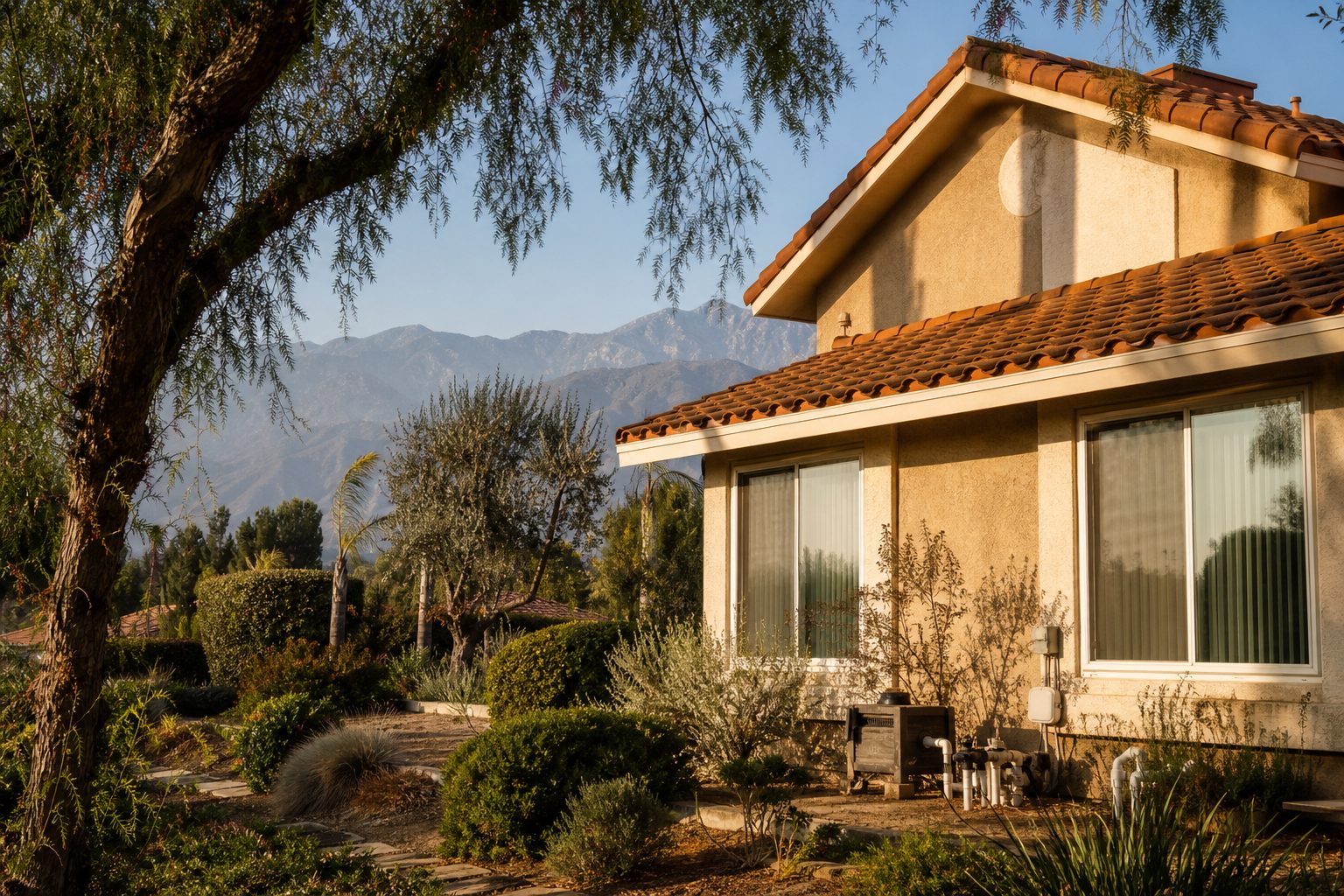
Why are utility bills so high in Rancho Cucamonga, and what can you actually do about them?
Utility costs in Rancho Cucamonga run roughly 49% above the national average, per LivabilityCalc cost-of-living data. The biggest driver is electricity: Southern California Edison’s average residential rate sits at approximately 34.5 cents per kWh as of January 2026, according to SCE, while the U.S. average is around 19 cents per kWh. Add hot Inland Empire summers, larger homes, pools, and irrigated landscaping, and those bills climb fast. The good news: the right rate plan, smart timing, and a few upgrades can cut your costs significantly.
—
> TLDR: Rancho Cucamonga utility bills are roughly 49% above the national average, driven primarily by SCE’s high electricity rates (approximately 34.5 cents per kWh), hot summers that push heavy AC use into expensive peak-pricing windows, large homes with pools, and aging housing stock. You can reduce costs by switching to the right SCE rate plan, shifting high-draw appliances outside the 4–9 PM peak window, upgrading to a variable-speed pool pump, adding insulation, and checking eligibility for CARE, FERA, or solar programs.
—
Why Rancho Cucamonga Utility Costs Matter Right Now
Whether you just inherited a family home during probate, you are budgeting for a move-up purchase in Alta Loma or Etiwanda, or you simply opened last month’s SCE bill and felt your stomach drop, understanding your utility costs is not optional here. It is a core part of owning a home in this market. With Rancho Cucamonga home values ranging from roughly $254,586 to over $5.2 million (per RealtyTrac), your monthly carrying costs deserve the same attention as your mortgage payment. We walk every buyer we work with through the true cost of ownership before they write an offer, because the purchase price is only part of the picture. Your monthly utility spend shapes your quality of life in this home for years to come.
If you are thinking about selling and want to understand what your home is worth before making any decisions, get your free home valuation at soldbyblay.com/home-value.
What Rancho Cucamonga Homeowners Typically Pay Each Month
Every home is different. Your actual bills depend on home age, insulation quality, rate plan, landscaping, pool equipment, and personal habits. But here is a realistic look at what monthly utility costs tend to look like across three common home types in Rancho Cucamonga, based on current rates and typical usage. These are illustrative ranges, not guarantees.
Condo or Townhome (Roughly 1,000 to 1,400 Square Feet)
- Electricity (summer): $80 to $140
- Electricity (winter): $50 to $90
- Gas: $25 to $50
- Water (CVWD): $60 to $100
- Sewer (CVWD plus IEUA): $35 to $50
- Trash (Burrtec): roughly $35 to $45
- Estimated Summer Monthly Total: roughly $235 to $385
Single-Family Home (Roughly 2,000 Square Feet)
- Electricity (summer): $180 to $300
- Electricity (winter): $100 to $175
- Gas: $45 to $90
- Water (CVWD): $100 to $180
- Sewer (CVWD plus IEUA): $50 to $70
- Trash (Burrtec): roughly $40 to $55
- Estimated Summer Monthly Total: roughly $515 to $895
Luxury or Larger Home With Pool (Roughly 3,500+ Square Feet)
- Electricity (summer): $350 to $600+
- Electricity (winter): $175 to $320
- Gas: $80 to $160
- Water (CVWD): $200 to $400+
- Sewer (CVWD plus IEUA): $70 to $100
- Trash (Burrtec): roughly $45 to $60
- Estimated Summer Monthly Total: roughly $920 to $1,320+
Assumptions: Electricity ranges based on SCE Schedule D tiered rates (30 cents per kWh for Tier 1, 40 cents per kWh for Tier 2 as of June 1, 2026, according to SCE tariff schedules), plus the $24.15 per month Base Services Charge. Water based on CVWD tiered rates effective January 1, 2026 ($28.26 meter charge for a standard three-quarter-inch meter, Tier 1 at $1.88 per HCF, according to CVWD). Pool homes assume a variable-speed pump running six to eight hours daily. EV charging not included. Verify current rates with each provider before budgeting.
If you are browsing condos and townhomes with lower utility overhead, you can search available inventory at soldbyblay.com. Likewise, if you are shopping for luxury homes over $2 million, we can pull current listings and help you budget the full monthly picture.
Why Electricity Costs So Much in Rancho Cucamonga
Your SCE bill is almost always the single biggest utility expense. Here is why.
California Rates Versus the National Average
According to SCE, a January 2026 advisory noted a slight 2.3% net decrease bringing the average residential rate to approximately 34.5 cents per kWh. That is still nearly double the national average of roughly 19 cents per kWh. California’s elevated rates reflect a combination of wildfire mitigation and grid hardening investments, renewable energy procurement requirements, aging infrastructure upgrades, and state-mandated programs. All of these flow through the CPUC’s rate-setting process and onto your monthly bill. We are not taking a political position here; these are simply the cost realities of owning a home in Southern California.
If you are relocating to Rancho Cucamonga from a state with lower energy costs, this is one of the biggest adjustments to prepare for. You can learn more about the Rancho Cucamonga housing market and local economic factors.
The Base Services Charge
Since November 2025, SCE applies California’s income-graduated Base Services Charge per CPUC Decision 24-05-028. For most residential customers, this is a fixed $24.15 per month. CARE customers pay about $6 and FERA customers pay about $12, according to SCE. This charge is not based on your energy use and cannot be lowered by reducing consumption. You cannot opt out. Think of it as your cost of being connected to the grid, whether you use 100 kWh or 1,000 kWh that month.
Tiered Versus Time-of-Use Rate Plans
Most Rancho Cucamonga homeowners are on one of two structures:
- Schedule D (Tiered): As of June 1, 2026, Schedule D charges 30 cents per kWh up to your baseline allowance and 40 cents above it, plus the daily Base Services Charge, according to SCE tariff schedules. Your monthly baseline allocation depends on your climate zone, and in a hot Rancho Cucamonga summer, most families with air conditioning blow past that baseline quickly.
- TOU-D-4-9PM (Time-of-Use): Peak hours run 4 to 9 PM on weekdays, a five-hour window when summer rates hit roughly 58 cents per kWh according to SCE. Off-peak hours cost about 34 cents per kWh in summer. If you run your AC, pool pump, dishwasher, and EV charger all during those five hours, you are paying nearly double the off-peak rate for every kilowatt.
- TOU-D-PRIME: This plan is for households with an EV or plug-in hybrid, a home battery, or an electric heat pump for water or space heating, and you must confirm the qualifying technology when you enroll, per SCE. It offers the lowest overnight rates and can be a strong fit for the right household.
What we tell our clients is this: there is no single “cheapest” plan. The right plan depends on when you use the most power. SCE offers a rate comparison tool (search “SCE rate comparison” on their site) that analyzes your actual usage and recommends the best fit.
Why Summers Hit Hardest in Rancho Cucamonga
Rancho Cucamonga maintains a Mediterranean semi-arid climate with over 280 sunny days annually, per city data. Average highs in July and August regularly push into the low 90s and above, and some days exceed 100 degrees. That means your air conditioner runs hard, and it runs right into SCE’s most expensive peak-pricing window from 4 to 9 PM, which is exactly when you get home, start cooking, and the house is at its hottest.
For a deeper dive on local temperatures and wind patterns, check out our post on how hot it gets in Rancho Cucamonga on the blog at soldbyblay.com.
What Drives Summer Bills Higher
- Home size. A 3,500-square-foot home in the Deer Creek or Haven View Estates neighborhoods simply has more space to cool than a 1,400-square-foot townhome near Victoria Gardens.
- Pools. Pool pumps are a hidden electricity hog. Older single-speed pumps running eight or more hours a day can add $75 to $150 per month in summer. Variable-speed pumps cut that dramatically. We cover pool economics in our post on whether pools, casitas, and guest houses add value to a $2 million home.
- Aging HVAC. Many inherited and older homes in Rancho Cucamonga were built during the city’s major growth periods in the 1970s through 1990s. An HVAC system that is 15 to 20 years old, single-pane windows, and minimal attic insulation can easily add 30% or more to your cooling costs compared to a home built to California’s current Title 24 energy code.
- EV charging. If you are charging an electric vehicle at home during peak hours, that alone can add $50 to $100 per month. Shifting charging to overnight hours on a TOU plan is one of the easiest wins available.
Gas, Water, Sewer, and Trash in Rancho Cucamonga
Electricity gets the most attention, but the rest of your utility stack matters too.
Natural Gas (SoCalGas)
Gas bills in Rancho Cucamonga follow a seasonal pattern: relatively low in summer (cooking, water heating) and higher in winter when your furnace kicks in. California gas rates have been volatile and trending upward in recent years. If you have an older gas furnace, gas water heater, and a gas pool heater, your winter gas bills can surprise you. Heat pump water heaters are an increasingly popular upgrade, and current rebates through TECH Clean California may help offset the cost. Verify current rebate availability with your installer.
Water (Cucamonga Valley Water District)
CVWD serves Rancho Cucamonga and uses a tiered pricing structure that penalizes high usage. As of January 1, 2026, the monthly meter charge for a standard three-quarter-inch residential meter is $28.26, with tiered usage rates of $1.88 per HCF at Tier 1, $2.33 at Tier 2, $3.98 at Tier 3, and $4.22 at Tier 4, according to CVWD’s published rate schedule. That tiered structure means the more you water, the more expensive each additional unit of water becomes.
This is where the big foothill lots in Alta Loma and Etiwanda make a real difference. A quarter-acre lot with turf, mature trees, and landscaping can push you deep into Tier 3 or Tier 4 pricing during summer. CVWD offers turf replacement rebates and smart irrigation controller programs. Verify current availability through CVWD directly.
Sewer charges include both a CVWD component and a regional treatment charge through the Inland Empire Utilities Agency. These are generally predictable and based on your winter water usage average.
Trash (Burrtec)
Burrtec provides residential trash, recycling, and green waste service in Rancho Cucamonga. Monthly rates vary by cart size and typically run in the $35 to $60 range. Verify current rates and billing details with Burrtec or the City of Rancho Cucamonga.
If you are evaluating neighborhoods with lower monthly overhead, is Etiwanda worth the premium? We break that down in our 2026 buyer’s guide on the blog, including how larger Etiwanda homes tend to come with larger utility bills.
How to Lower Your Electricity Bill in Rancho Cucamonga
Here is a practical checklist. None of these require a massive investment to start:
- Pick the right SCE rate plan. Use SCE’s rate comparison tool to analyze your actual usage history and find the plan that costs you the least. This single step can save some households $20 to $50 per month.
- Shift high-draw activities out of peak hours. Run your dishwasher, laundry, and pool pump before 4 PM or after 9 PM. Program your EV to charge overnight.
- Pre-cool your home before 4 PM. Set your thermostat to 72 to 74 degrees by mid-afternoon, then let it float up to 78 during peak hours. Your home’s thermal mass will hold the cool air longer than you expect.
- Install a smart thermostat. Programmable scheduling alone can reduce cooling costs by 10% to 15%.
- Service or replace aging HVAC. A system over 15 years old loses efficiency every year. Check our pre-listing repairs and upgrades guide for how this investment pays off at resale.
- Seal ducts and add insulation. Leaky ducts in an unconditioned attic are one of the most common energy wastes in older Rancho Cucamonga homes.
- Consider solar plus battery storage. Even after changes to California’s net metering program, solar can still reduce your SCE bill substantially. We break down the current math in our post on whether solar is still worth it in Rancho Cucamonga at soldbyblay.com.
- Check CARE, FERA, and Medical Baseline eligibility. CARE provides at least 30% off your bill for qualifying households. FERA offers 18% off. Medical Baseline provides additional baseline allocation for medically qualifying households, per SCE.
How to Lower Your Water and Gas Bills in Rancho Cucamonga
- Install smart irrigation controllers. CVWD has offered rebates for weather-based controllers. These adjust watering automatically based on temperature and rainfall.
- Switch to drip irrigation for garden beds and shrubs. Drip systems use a fraction of the water that spray heads do.
- Replace turf with drought-tolerant landscaping. CVWD’s turf replacement rebate program can offset part of the cost. Verify current availability and dollar amounts directly with CVWD.
- Fix leaks promptly. A dripping faucet or running toilet can waste thousands of gallons and push you into higher water tiers.
- Use a pool cover. Covers reduce evaporation dramatically, which lowers both your water bill and your pool heater gas costs.
- Consider a heat pump water heater. These use electricity instead of gas and can cut water heating costs significantly, especially when paired with off-peak electricity rates.
Buying a Bigger Home in Rancho Cucamonga? Budget the True Monthly Cost
If you are moving up from a townhome to a 3,000-square-foot home with a pool in Etiwanda or Alta Loma, your utility bill could easily double or triple. That is not a reason to avoid the home; it is a reason to budget accurately. What we always recommend to buyers is this: ask the seller for 12 months of utility bills before you finalize your decision. Also check the age of the HVAC system, whether solar panels are owned or leased, what net metering version the system is on, and whether the pool pump is single-speed or variable-speed.
Newer homes built to California’s Title 24 energy code, including communities

Leave a Reply