

Can you sell a probate home as-is in Rancho Cucamonga?
Yes. California law does not require executors, administrators, or heirs to make any repairs before selling a probate home, and selling as-is is one of the most common paths families choose. That said, the home’s condition at listing directly shapes which buyers show up, what price they offer, and how smoothly escrow closes. Certain disclosures and state-required safety items still apply regardless of as-is terms.
We sell every property as-is. We also share a clear picture of how the home could be improved for maximum value, what each option costs, and which buyers and price ranges each condition level tends to attract. The final decision always belongs to the family. For a broader look at the full probate selling process, see our step-by-step guide on selling a home in probate in the Inland Empire. For probate and trust-specific guidance, visit our probate and trust real estate page.
*This article is general information, not legal or tax advice. Consult a probate or estate attorney and a CPA about your specific situation.*
—
Why This Matters Right Now in Rancho Cucamonga
Rancho Cucamonga’s homeownership rate sits at 62.3%, per U.S. Census American Community Survey data, which is notably higher than the California state average. That means a significant number of local families will eventually face the question of what to do with a parent’s or loved one’s home after they pass. Many of these properties, particularly in established neighborhoods built during the city’s development boom from the 1970s through the 1990s, carry decades of deferred maintenance. You may be staring at an outdated kitchen, aging systems, or a yard that has not been touched in years, and wondering whether you need to invest money the estate may not have readily available. The short answer: you do not. But understanding your options, and what each one means for the sale, puts you in a position to make the best decision for your family.
—
What “As-Is” Really Means in a Rancho Cucamonga Probate Sale
When a probate home is listed as-is, the estate is not obligated to fix anything. Not the leaking faucet, not the cracked driveway, not the aging HVAC. The home goes to market in its current condition, and the buyer accepts it that way.
Buyers Can Still Inspect
Selling as-is does not prevent a buyer from conducting inspections. In a standard California residential purchase agreement, buyers typically retain the right to inspect the property and, depending on the terms, may have contingency rights based on what they find. Some buyers, particularly investors and cash buyers, may waive inspections or shorten contingency periods, while financed buyers are more likely to use them fully.
Disclosure Duties Still Apply
Even in probate, disclosure obligations exist. Under California Civil Code, executors and administrators who have never occupied the property may be exempt from completing the Transfer Disclosure Statement (TDS). However, material facts that affect the property’s value or desirability must still be disclosed if the representative has personal knowledge of them. A Natural Hazard Disclosure report is also typically required in California sales regardless of probate status. Always confirm the current requirements with your estate attorney before listing.
State-Required Safety Items
California law mandates working smoke detectors and carbon monoxide alarms in residential properties at the point of sale. As of 2026, newly installed battery-only smoke detectors must have a 10-year non-replaceable battery. Water heater strapping is also a California requirement under the state Plumbing Code. Even in a TDS-exempt transaction, many brokerages will require the use of C.A.R. form WHSD (Water Heater and Smoke Detector Statement of Compliance). These are typically low-cost items, but they are worth knowing about upfront.
—
How Probate Authority Affects an As-Is Sale in Rancho Cucamonga
The type of authority granted to the personal representative directly affects how the sale unfolds.
Full Authority Under the IAEA
Under the Independent Administration of Estates Act (California Probate Code Sections 10400 through 10592), a personal representative granted full authority can sell real property without a court confirmation hearing. They must send a Notice of Proposed Action to all interested parties at least 15 days before the sale, and if no one objects, the accepted offer is the final offer. No overbidding. This makes the process smoother and more predictable for both the estate and buyers.
Limited Authority and Court Confirmation
Without full authority, the sale must go to court for confirmation. The judge hears the sale terms, and overbidding is permitted in open court. The accepted sale price must generally be at least 90% of the appraised value set by the court-appointed Probate Referee. The minimum overbid is calculated as 10% of the first $10,000 of the original bid plus 5% of the balance.
In practical terms for a Rancho Cucamonga estate, full authority tends to attract a broader buyer pool because financed buyers and their lenders are more comfortable with a predictable timeline. Limited authority can add weeks to escrow and introduces uncertainty that some buyers, especially those using conventional or government-backed loans, may not want to navigate.
We keep probate procedures at a high level here because your estate attorney is the right guide for specifics. For additional context on the tax side of selling an inherited property, see our guide on whether you pay taxes when you sell an inherited home in California.
—
Our Approach: As-Is, With a Clear Path to Maximum Value
We never pressure families in either direction. Here is how we handle every probate listing in Rancho Cucamonga:
- We list every property as-is. No seller is ever required to make repairs or improvements to work with us.
- We provide suggestions. Before listing, we walk through the home with you and lay out exactly what could be done to broaden the buyer pool and strengthen pricing, along with honest cost and time estimates for each option.
- We explain who buys at each condition level. Different buyers bring different offers, and you deserve to understand the tradeoffs before choosing a path.
- The decision is always yours. Whether you list it tomorrow with belongings still inside or invest in a cosmetic refresh first, we support the path your family chooses.
If you are still weighing whether to sell, rent, or keep the property, our guide on whether to sell, rent, or keep a parent’s home in the Inland Empire walks through that broader decision.
—
The Condition Spectrum: Who Buys at Each Stage in Rancho Cucamonga
Think of property condition as a spectrum. Each point on it attracts a different buyer profile and pricing range.
Stage 1: As-Is, Untouched
- Typical situation: Belongings still in the home, deferred maintenance, possibly outdated systems
- Who it attracts: Cash investors, contractors, flippers, and some value-seeking owner-occupants
- Pricing tendency: Tends to be the lowest price point relative to comparable move-in-ready homes in the same area
- Time and cost to the seller: Minimal; the fastest path to listing
- What to know: In the current Rancho Cucamonga market, flip margins are thinner than they have been in recent years, according to Rancho Cucamonga housing market analysis for 2026. That means investor offers may not be as aggressive as they were during the 2021 and 2022 peak, but cash buyers still value speed and certainty.
Stage 2: Cleaned Out and Cleaned Up
- Typical work: Professional clean-out of belongings, deep cleaning, yard cleanup
- Who it attracts: A broader pool that now includes more owner-occupant buyers who can see the home’s potential
- Pricing tendency: Often a modest bump relative to untouched condition, because buyer perception shifts significantly when a home feels open and cared for
- Time and cost to the seller: Usually a few days to a couple of weeks; costs vary by volume of belongings and property size
Stage 3: Cosmetic Refresh
- Typical work: Fresh interior paint, new flooring, updated light fixtures, landscaping, minor repairs
- Who it attracts: More financed owner-occupant buyers, including FHA and VA buyers (provided the home meets their minimum property condition standards)
- Pricing tendency: Typically stronger than as-is; the home now competes with lightly updated resale inventory
- Time and cost to the seller: Several weeks; meaningful out-of-pocket cost, though usually less than heirs expect
- What to know: For higher-value estate homes in neighborhoods like Alta Loma or Etiwanda, buyers at this price point have specific expectations. Our guide on what luxury homebuyers want in 2026 outlines what those buyers notice most.
Stage 4: Updated or Renovated
- Typical work: Kitchen and bathroom remodels, new systems (HVAC, plumbing, electrical), major structural work
- Who it attracts: The broadest retail buyer pool; competes head-to-head with move-in-ready resale homes
- Pricing tendency: Highest price potential, but also the highest upfront cost, longest timeline, and greatest risk if the market shifts
- What to know: A renovated probate home in Rancho Cucamonga competes directly with both resale and new construction. Our comparison of new construction vs. resale in Rancho Cucamonga provides context for what buyers weigh at that level.
Want to understand where your inherited property falls on this spectrum? Request a free home valuation to get a realistic starting point.
—
Financing and Buyer Pool Realities in Rancho Cucamonga
This is where condition has a direct, practical impact that many families do not expect.
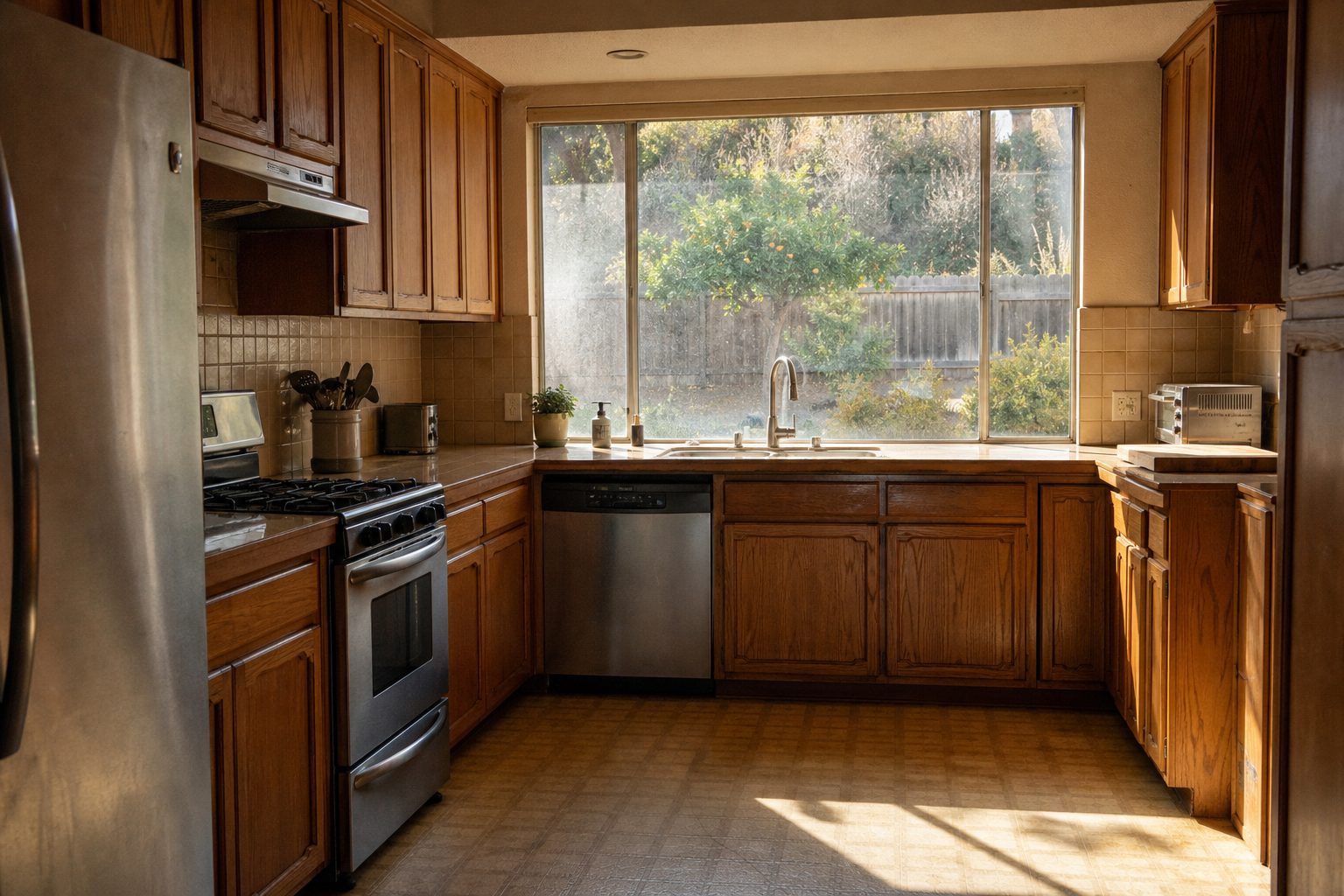
Government-backed loans have minimum property standards. FHA and VA loans require that the home meet certain condition thresholds, including functioning systems, a sound roof, and no health or safety hazards. A home with major deferred maintenance, such as a non-functioning furnace, significant roof damage, or active plumbing leaks, may not qualify for FHA loans or VA financing. That narrows the buyer pool primarily to cash buyers and conventional borrowers whose lenders may still require an acceptable appraisal.
Why this matters for pricing. When you limit who can buy, you limit competition. Fewer competing offers generally means less upward pressure on price. In a Rancho Cucamonga market where homes sell in a median of roughly 25 to 26 days, according to mid-2026 data from multiple market sources, a well-priced, condition-appropriate listing still moves. But a home that sits because it is priced above what its condition supports can go stale quickly.
Pricing right from the start matters more than ever in a balanced market. Our team’s approach is to price based on the home’s actual condition and the realistic buyer pool, not on what a fully renovated comparable sold for down the street.
—
Common Improvements Rancho Cucamonga Families Consider
When families do choose to make improvements before listing, these are the most common starting points:
- Clean-out and deep clean: Removes the emotional weight of belongings and allows buyers to see the home itself
- Interior paint: Neutral tones in good condition make a home feel significantly more move-in ready
- Flooring: Replacing worn carpet or damaged flooring is one of the most visible improvements per dollar
- Landscaping and curb appeal: A trimmed yard, cleared walkways, and a clean front entry change the first impression
- Minor repairs: Fixing leaky faucets, replacing broken light switches, patching drywall
Larger improvements, like kitchen and bathroom remodels, roof replacement, or system upgrades, can make sense in some situations, but they carry more risk. The cost may not fully translate into a higher sale price, and the timeline extends the estate’s carrying costs (property taxes, insurance, utilities, and potentially HOA or CFD assessments, depending on the property’s location within Rancho Cucamonga).
For estate homes in the foothill areas, California defensible-space requirements in fire zones may also apply. Properties in higher fire severity zones may need vegetation management and other compliance steps, which are worth discussing with both your real estate agent and your estate attorney.
—
Using Estate Funds for Repairs Before a Rancho Cucamonga Probate Sale
If the family decides to invest in improvements, the question of who pays and how naturally comes up.
- Estate funds can generally be used for maintenance, preservation, and improvement of estate property. This is a common and recognized use of estate assets. However, the personal representative should coordinate with the estate attorney before committing to significant expenses.
- Keep all heirs informed. Transparency about repair decisions and costs reduces the risk of disputes later. When multiple heirs are involved, clear communication is essential.
- Document everything. Receipts, contractor agreements, before-and-after photos, and written approvals from co-heirs all protect the personal representative.
- Selling expenses factor into the estate’s tax picture. Costs associated with preparing the home for sale may affect the estate’s tax obligations. Our guide on taxes when selling an inherited home in California covers this in more detail.
—
Rancho Cucamonga Details That Affect a Probate As-Is Sale
Rancho Cucamonga is not one-size-fits-all. The specifics of your inherited property’s location within the city matter.
- Neighborhood era matters. Many homes in Rancho Cucamonga’s established core date to the 1970s through 1990s, which means they may have original roofing, older electrical panels, galvanized plumbing, or single-pane windows. Homes in newer areas of Etiwanda with foothill views and top schools may need less updating. Knowing the era of your property helps set realistic expectations for both condition and buyer perception.
- Foothill fire zones. Properties in the foothill areas near the San Gabriel Mountains may fall within state-designated fire hazard severity zones. Defensible-space requirements, which include vegetation management around the structure, can apply at the time of sale and should be confirmed with your agent and estate attorney.
- HOA and CFD assessments. Some Rancho Cucamonga neighborhoods carry HOA dues or Community Facilities District (CFD) assessments that are tied to the property address. These ongoing costs are part of the carrying cost calculation families should factor in when deciding how quickly to sell.
- Property taxes and Proposition 19. Since February 2021, California’s Proposition 19 eliminated the parent-to-child property tax reassessment exclusion for non-primary residences. If heirs do not move into the inherited property as their primary residence within one year, the property will be reassessed to current market value. With Rancho Cucamonga home values in the range of $765,000 to $826,000 as of mid-2026 (per multiple market data sources), and effective property tax rates running between roughly 1.1% and 1.25%, this reassessment can create a substantial increase in annual property tax obligations. This is one of the reasons many families prioritize a timely sale.
For current Rancho Cucamonga listings, browse homes for sale in Rancho Cucamonga or explore homes in Alta Loma and Etiwanda specifically.
—
How to Decide What Is Right for Your Family
Every probate sale is different. Here is a framework for making the decision:
- Timeline: How quickly do you need or want to close? Carrying costs add up, and a longer timeline for renovations means more months of property taxes, insurance, and utilities.
- Budget: Does the estate have funds available for improvements, or would repairs require heirs to contribute out of pocket?
- Heirs’ goals: Are all heirs aligned on the strategy? Disagreements about whether to invest in repairs or sell quickly are common, and early communication prevents larger conflicts.
- Market conditions: In a balanced to slightly seller-leaning market like Rancho Cucamonga’s in 2026, well-priced homes still sell efficiently. Overpricing relative to condition, however, leads to longer days on market and eventual price reductions. According to mid-2026 data from Orchard, 33.96% of homes listed in Rancho Cucamonga dropped in price, up 12.8 points year-over-year.
- Emotional capacity: Selling a loved one’s home is not just a financial decision. Cleaning out belongings, making decisions about personal items, and walking through the home during showings can be emotionally heavy. There is no wrong answer about how much you want to take on.
If you are still weighing whether selling is the right move at all, our guide on whether to sell, rent, or keep a parent’s home walks through the full decision

Leave a Reply