
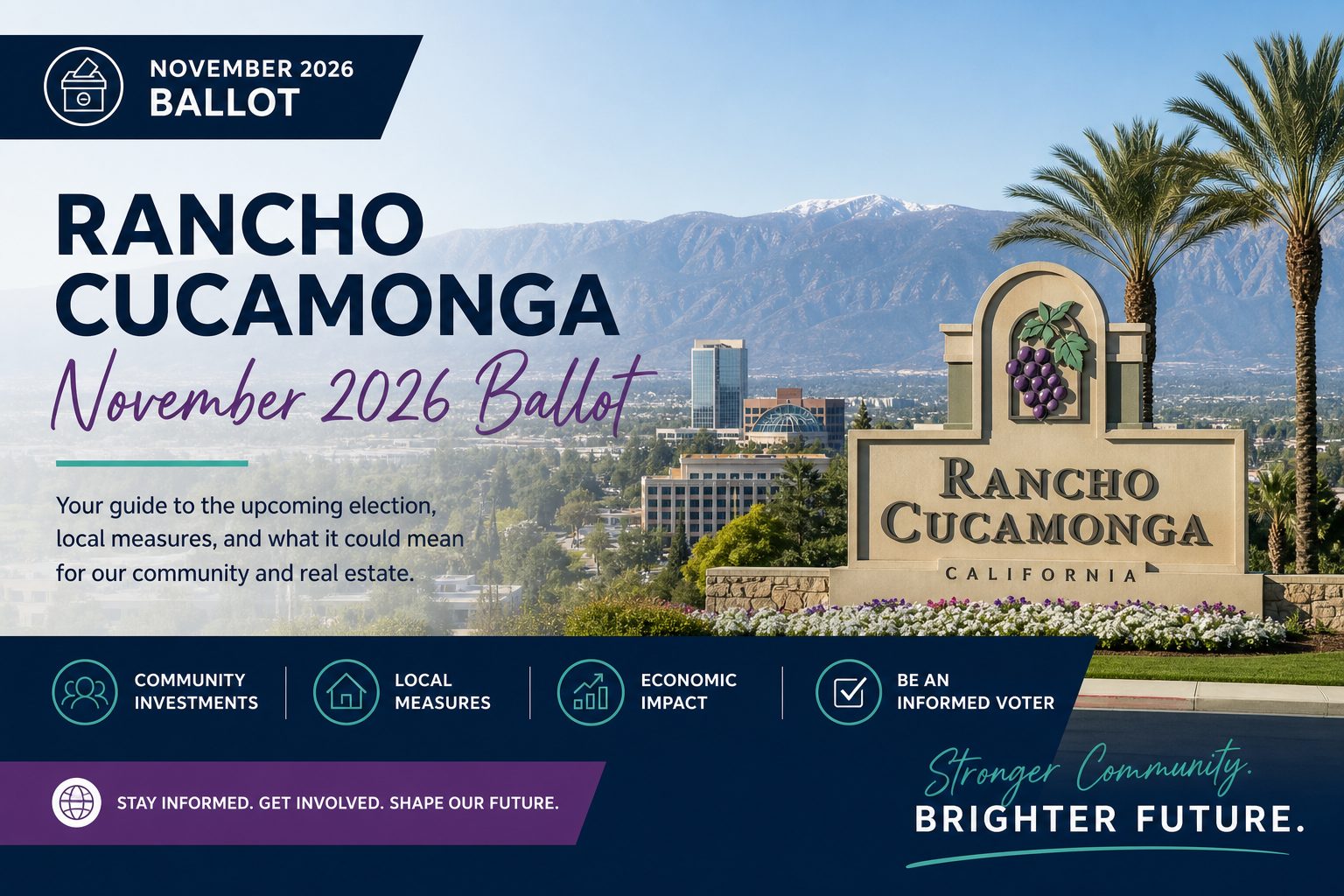
What’s on the November 2026 ballot for Rancho Cucamonga homeowners and buyers?
California voters will decide 14 statewide propositions on November 3, 2026. Several relate directly to housing, homebuying, property, and taxes. Below, we explain what each would do, what a yes or no vote means, and who supports and opposes it, without recommendations, so you can decide for yourself.
*Last updated: October 3, 2026*
> *This article is nonpartisan general information, not legal, tax, or voting advice. Sold By Blay does not endorse or oppose any ballot measure. Review the official California Voter Information Guide before voting. Information as of October 3, 2026; check official sources for the latest details.*
—
Why This Matters Right Now for Rancho Cucamonga
If you own property in Rancho Cucamonga, you are about to vote on measures that could shape housing programs, tax rules, and development policy for years to come. As of June 2026, the median home sale price here is approximately $826,000, according to local market data. That means the financial stakes of any new bond, tax, or housing program are real and personal for you.
Whether you are buying your first home, managing an inherited property, or simply protecting the equity you have built, understanding what each proposition would actually do, not what campaign ads tell you, puts you in a stronger position. Mail ballots begin arriving on or before October 5, 2026. The voter registration deadline is October 19, 2026. Election Day is November 3, 2026, with polls open from 7:00 a.m. to 8:00 p.m. You have time to read, but not much.
—
The Housing, Property, and Tax Measures at a Glance
Here is a quick overview of every proposition that directly touches housing, homebuying, property, or taxes. We go deeper on each one below.
- Prop 1 (Affordable Housing Bond): Would borrow $11.25 billion for affordable housing and veteran home loans. Primarily affects renters, affordable housing developers, and veterans.
- Prop 37 (Homebuying Loan Program): Up to $25 billion in revenue bonds for down payment assistance on new homes. Primarily affects middle-income homebuyers and new home builders.
- Prop 45 (Environmental Review Deadlines): Would amend CEQA to speed up environmental reviews for housing and infrastructure. Primarily affects developers, future homebuyers, and environmental advocates.
- Prop 43 (Local Special Tax Threshold): Would require two-thirds voter approval, rather than simple majority, for citizen-initiated local special taxes. Primarily affects local governments, homeowners, and taxpayers.
- Prop 3 (High-Earner Income Tax): Would make the 2012 high-earner tax rates permanent beyond 2031. Primarily affects high-income earners, schools, and healthcare programs.
- Prop 40 (Wealth Tax): One-time 5% tax on California billionaires. Primarily affects roughly 200 high-asset individuals and public healthcare.
- Prop 41 (Tax Revenue Spending Limit): Would require audits of new tax programs and count new tax revenue toward the state spending cap. Primarily affects future tax programs and the state budget.
- Prop 42 (Personal Property Tax Ban): Would ban new taxes on personal property ownership. Primarily affects future wealth tax legislation and property owners.
- Prop 2 (State Reserve Fund): Would raise the rainy day fund deposit cap from 10% to 20%. Primarily affects state budget stability and all taxpayers.
So which ones matter most to you? That depends on whether you are buying, selling, or holding property in Rancho Cucamonga. Let us walk through each one.
—
Proposition 1: Affordable Housing Bond in Rancho Cucamonga Context
Official Ballot Title: Authorizes Bonds for Housing Affordability Programs. Legislative Statute.
What it would do: Proposition 1 would allow the state to sell $11.25 billion in bonds to fund affordable housing projects, according to the California Secretary of State. Of that amount, $1.25 billion would go toward veteran housing. The rest would support rental housing, student housing, farmworker housing, and homeownership programs.
What a YES vote means: The state would be authorized to sell general obligation bonds totaling $11.25 billion to fund affordable housing acquisition, construction, rehabilitation, and preservation, plus a veteran home loan program.
What a NO vote means: The state would not issue bonds for these affordable housing and veteran housing purposes.
Fiscal effect: According to the Legislative Analyst’s Office, general obligation bonds of this type are repaid from the state general fund, not from local property taxes. Repayment would include principal and interest over the life of the bonds.
Who it could affect locally: San Bernardino County, including Rancho Cucamonga, has active affordable housing development pipelines. State bond programs of this type have historically funded projects throughout the Inland Empire. Whether and how funds would be allocated to specific local developments would depend on program rules and competitive applications.
Supporters (as publicly reported): The California Democratic Party, Governor Gavin Newsom, Democratic state lawmakers, the California Apartment Association, and AFL-CIO California, as reported by CalMatters (June 25–30, 2026).
Opponents (as publicly reported): Republican state lawmakers, as reported by CalMatters (June 25–30, 2026). The California Republican Party was reported as neutral. No formal opposition arguments were available in our searches as of October 3, 2026.
—
Proposition 37: Homebuying Loan Program and What It Means for Rancho Cucamonga Buyers
Official Ballot Title: Creates Loan Program for Middle-Income Buyers of Qualified New Homes. Initiative Statute.
What it would do: Proposition 37 would create a California down payment assistance loan program. CalHFA (California Housing Finance Agency) would sell up to $25 billion in revenue bonds and use the proceeds to offer fixed-rate loans covering up to 17% of the purchase price on homes priced under $1.5 million. Buyers would need to contribute at least 3% as a down payment.
Who qualifies: Homebuyers earning less than 200% of area median income. For San Bernardino County, the area median income is $106,500, according to HCD Revised 2026 State Income Limits. That means households earning up to roughly $213,000 could potentially qualify.
What does that look like for Rancho Cucamonga? With the median home sale price at approximately $826,000 as of June 2026, many properties here fall well below the $1.5 million cap. The program would apply to new homes only.
Fiscal effect: According to the Legislative Analyst’s Office, there would be no direct state or local cost because the revenue bonds would be repaid by homebuyers through their loan payments, not by taxpayers.
What a YES vote means: The state would create this loan program for middle-income homebuyers purchasing qualified new homes.
What a NO vote means: The program would not be created.
Supporters (as publicly reported): Former Senate Majority Leader Bob Hertzberg, Building a Better California, the California Association of REALTORS®, and carpenters’ unions, as reported by CalMatters (June 25–30, 2026).
Opponents (as publicly reported): No formal opposition arguments were available in our searches as of October 3, 2026.
—
Proposition 45: Environmental Review Deadlines for Housing and Infrastructure
Official Ballot Title: Amends Environmental Review Process. Initiative Statute.
What it would do: Proposition 45 would amend the California Environmental Quality Act (CEQA) to create deadlines for environmental reviews of most housing, transportation, water, health, and clean energy projects. It would also limit courts’ ability to stop or delay developments during review disputes.
If you have ever wondered why new housing can take years to break ground in California, CEQA review timelines are frequently cited as a factor. This measure addresses that process directly.
What a YES vote means: New deadlines and court limitations would apply to environmental reviews for covered projects.
What a NO vote means: The current CEQA review process would remain unchanged.
Supporters (as publicly reported): The California Chamber of Commerce, the California Building Industry Association, PG&E, and Edison, as reported by CalMatters (June 25–30, 2026).
Opponents (as publicly reported): A coalition of environmental advocates and the State Building and Construction Trades Council, as reported by CalMatters (June 25–30, 2026).
—
Proposition 43: Local Special Tax Threshold for Rancho Cucamonga Taxpayers
Official Ballot Title: Raises Threshold for Local Special Tax Measures. Initiative Statute.
What it would do: Proposition 43 would require two-thirds voter approval, rather than a simple majority, for citizen-initiated local special taxes. This would restore the two-thirds threshold that some jurisdictions had bypassed.
Why does this matter to you as a Rancho Cucamonga homeowner? Local special taxes can include parcel taxes for schools, infrastructure, or services. Changing the required approval threshold affects how easily new local taxes can be enacted.
What a YES vote means: Citizen-initiated local special tax measures would need two-thirds voter approval to pass.
What a NO vote means: The current threshold (simple majority for citizen-initiated measures in some cases) would remain.
Supporters (as publicly reported): Howard Jarvis Taxpayers Association, as reported by CalMatters (June 25–30, 2026).
Opponents (as publicly reported): No formal opposition arguments were available in our searches as of October 3, 2026.
—
Proposition 3: High-Earner Income Tax Extension
Official Ballot Title: Provides Permanent Funding for Schools and Health Care by Extending Existing Tax on High Incomes. Legislative Statute.
What it would do: Proposition 3 would make permanent a temporary income tax (up to 12%) on high earners, first approved by voters in 2012. It applies to household income over approximately $721,000 for couples and $360,000 for individuals. Without this measure, these rates are currently set to expire in 2031.
What a YES vote means: The higher income tax rates on high earners would become permanent.
What a NO vote means: The higher rates would expire as scheduled in 2031, and income tax rates for those earners would return to pre-2012 levels.
Supporters (as publicly reported): Teachers’ and school employees’ unions, as reported by CalMatters (June 25–30, 2026).
Opponents (as publicly reported): California Taxpayers Association, as reported by CalMatters (June 25–30, 2026).
—
Propositions 40, 41, and 42: The Wealth Tax and Related Measures
These three propositions are connected. Understanding them together is important because if conflicting measures both pass, the one with more votes prevails, as reported by NBC San Diego.
Proposition 40: One-Time Wealth Tax
Proposition 40 would impose a one-time 5% wealth tax on roughly 200 California billionaires, paid over five years. Revenue would fund public healthcare programs.
What a YES vote means: The one-time wealth tax would be imposed.
What a NO vote means: The tax would not be imposed.
Proposition 41: Tax Revenue Spending Limits
Proposition 41 would require audits of programs funded by new taxes and count new tax revenue toward the state spending cap. This could limit how revenue from measures like Proposition 40 is spent.
What a YES vote means: New tax revenue would count toward the state spending cap, and audits would be required.
What a NO vote means: Current rules for new tax revenue would remain.
Proposition 42: Personal Property Tax Ban
Proposition 42 would prohibit new state taxes on personal property ownership and ban certain retroactive state taxes. This measure directly conflicts with Proposition 40.
What a YES vote means: New personal property taxes would be banned.
What a NO vote means: The legislature would retain current authority regarding personal property taxes.
How they interact: If Propositions 40 and 42 both pass, the one with more votes prevails, as reported. Proposition 41 could further limit how any new tax revenue is spent. Review all three together before voting.
Supporters and opponents (as publicly reported): Detailed supporter and opponent lists for these measures were limited in available reporting as of October 3, 2026. Check the official California Voter Information Guide for filed arguments.
—
Proposition 2: State Reserve Fund
Official Ballot Title: Increases State’s Rainy Day Fund. Legislative Statute.
What it would do: Proposition 2 would allow the state to deposit up to 20% of general fund tax revenue into its rainy day fund each year, up from 10%. It would also use some revenue to pay down federal unemployment insurance debt.
What a YES vote means: The state could save a larger share of revenue in reserve.
What a NO vote means: The current 10% cap would remain.
This measure does not directly change property taxes or housing programs, but a stronger state reserve could affect the state’s ability to fund programs during economic downturns.
—
Are There Local Housing or Tax Measures in Rancho Cucamonga?
As of October 3, 2026, no local Rancho Cucamonga or San Bernardino County housing, property, or tax ballot measures were found in our research. We recommend checking the San Bernardino County Registrar of Voters for the final certified list of local measures before you vote. Local school district bond measures or special district assessments, which can affect your property tax bill, sometimes appear on the ballot in Rancho Cucamonga. The Etiwanda School District, Alta Loma School District, Central School District, and Chaffey Joint Union High School District all serve parts of the city.
—

The Rest of the November 2026 Statewide Ballot
Five additional statewide propositions round out the 14-measure ballot. While they do not directly affect housing or property taxes, here is a brief, neutral description of each:
- Proposition 39 (Voter ID): Would require voter identification at polling places.
- Proposition 4 (Public Campaign Financing): Would establish a public campaign financing program.
- Proposition 5 (Recall Election Reform): Would change procedures for recall elections.
- Proposition 44 (Clinic Funding): Would provide funding for community health clinics.
- Proposition 38 (Immunology Research Bond): Would authorize $8.4 billion in bonds for immunology research.
Review the official California Voter Information Guide for full details on all 14 measures.
—
How and When to Vote in San Bernardino County
Here are the key dates and options for voting in the November 3, 2026 election, according to the official Voter Information Guide and the California Secretary of State:
- Mail ballots: Begin mailing on or before October 5, 2026. You can return your ballot by mail (postmarked by Election Day), at any ballot drop box, or at any vote center.
- Voter registration deadline: October 19, 2026.
- Same-day conditional registration: If you miss the deadline, you can register and vote conditionally at any vote center through Election Day.
- Election Day: November 3, 2026. Polls and vote centers are open 7:00 a.m. to 8:00 p.m.
- Official resources: The California Voter Information Guide (from the Secretary of State) and the San Bernardino County Registrar of Voters both provide full details on measures, candidates, and your nearest vote center. Look for them by name in a search engine or contact the county registrar’s office directly.
—
What This Means for Rancho Cucamonga Homeowners and Buyers
Ballot outcomes can shape housing programs, tax policy, and development rules for years. For homeowners in Rancho Cucamonga, where the effective property tax rate is approximately 0.71% (roughly $5,557 per year on a median-value home, per local assessor data), even small changes to tax structure or bond programs add up over time.
If you are navigating a probate or inherited-property situation, these propositions matter in a different way. Any future changes to property tax rules, development fees, or housing programs could affect the value and carrying costs of an inherited home. We always encourage our clients to consult a CPA or financial advisor about how specific ballot outcomes might affect their personal tax situation.
The best thing you can do right now is read the official California Voter Information Guide and vote your conscience.
—
Frequently Asked Questions
What propositions are on the November 2026 California ballot?
California voters will decide 14 statewide propositions on November 3, 2026. They cover housing bonds, homebuying loans, environmental review reform, local tax thresholds, high-earner income taxes, a wealth tax, state reserves, voter ID, campaign financing, recall reform, clinic funding, and immunology research bonds. The full list and official descriptions are available in the California Voter Information Guide from the Secretary of State.
What is Proposition 1 in California?
Proposition 1 would authorize the state to sell $11.25 billion in general obligation bonds for affordable housing projects, including $1.25 billion for veteran home loans. According to the Legislative Analyst’s Office, repayment comes from the state general fund, not from local property taxes. The measure is a legislative statute placed on the ballot by the state legislature.
What is Proposition 37 and who qualifies?
Proposition 37 would create a state-run down payment assistance loan program for middle-income buyers purchasing qualified new homes priced under $1.5 million. Buyers earning less than 200% of area median income would be eligible. For San Bernardino County, the area median income is $106,500 (per HCD Revised 2026 State Income Limits), meaning households earning up to roughly $213,000 could potentially qualify.
Would Proposition 1 raise my property taxes in Rancho Cucamonga?
According to the Legislative Analyst’s Office, Proposition 1’s general obligation bonds would be repaid from the state general fund, not from local property taxes. Your property tax bill would not include a line item for Proposition 1 bond repayment. However, the state general fund is supported by state income and sales taxes.
What does Proposition 45 change about CEQA?
Proposition 45 would create deadlines for environmental reviews under the California Environmental Quality Act for most housing, transportation, water, health, and clean energy projects. It would also limit courts’ ability to stop or delay developments during review disputes. Supporters say it would speed up housing construction. Opponents raise concerns about environmental protections.
What does Proposition 43 do to local taxes?
Proposition 43 would require two-thirds voter approval, instead of a simple majority, for citizen-initiated local special tax measures. This could make it harder to pass new local parcel taxes or special assessments in Rancho Cucamonga and other California cities.
What happens if Propositions 40 and 42 both pass?
If Propositions 40 (one-time wealth tax) and 42 (personal property tax ban) both pass, the one with more votes prevails, as reported by NBC San Diego. This is standard procedure in California when conflicting ballot measures are approved by voters simultaneously.
Who does Proposition 3 affect?
Proposition 3 would make permanent the higher income tax rates on earners with household income above approximately $721,000 (couples) or $360,000 (individuals). If you earn below those thresholds, the measure would not change your income tax rate. Revenue funds schools and healthcare programs.
When is the voter registration deadline in California for November 2026?
The voter registration deadline for the November 3, 2026 election is October 19, 2026, according to the official Voter Information Guide. If you miss it, you can still register and vote conditionally at any vote center through Election Day using same-day conditional registration.
Where can I find the official voter guide for San Bernardino County?
The California Voter Information Guide is published by the Secretary of State and mailed to registered voters. You can also find it by searching for “California Voter Information Guide” online. For local measures and vote center locations, search for the San Bernardino County Registrar of Voters.
Are there local measures on the Rancho Cucamonga ballot in November 2026?
As of October 3, 2026, no local Rancho Cucamonga or San Bernardino County housing, property, or tax ballot measures were found in our research. Check the San Bernardino County Registrar of Voters for the final certified list of local measures.
How could these ballot measures affect inherited property in Rancho Cucamonga?
Propositions that change housing programs, tax rules, or development policies can affect the carrying costs, market value, and sale options for inherited properties over time. For example, new bond programs could bring more affordable housing competition, while tax changes could affect holding costs. Consult a CPA or probate attorney for advice specific to your situation.
—
The Bottom Line
The November 2026 ballot carries 14 statewide propositions, and several could shape housing, tax, and development policy for Rancho Cucamonga homeowners and buyers for years to come. We encourage you to read the official California Voter Information Guide, understand what each measure would actually do, and vote your conscience on November 3, 2026.
—
Have questions about your home or your next move in Rancho Cucamonga? We are here to help. Whether you are buying, selling, navigating probate, or just planning ahead, we will give you honest advice and a clear plan.
Get your free home valuation at soldbyblay.com/home-value/
Schedule a consultation at soldbyblay.com/contact
Brent Blay | Sold By Blay | Park Regency Realty | DRE #02068178 📞 909-641-8751 | ✉️ brentblay@parkregency.com | soldbyblay.com Your family deserves the best.
—
*Written by Sold By Blay at Park Regency Realty, specialists in luxury, probate, and trust real estate in Rancho Cucamonga and the Inland Empire.*

Leave a Reply