


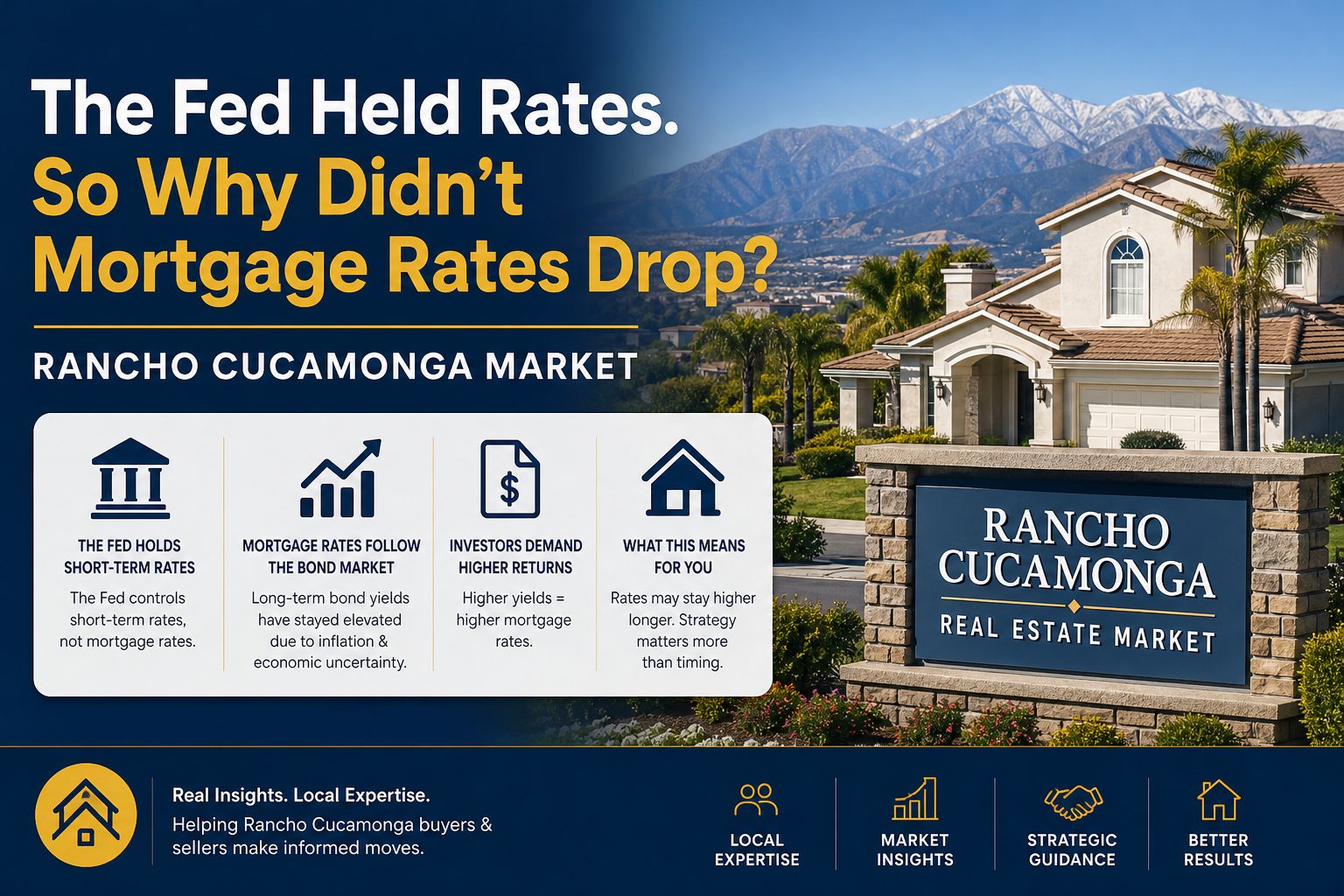
If the Federal Reserve held interest rates steady on October 28, 2026, why are mortgage rates in Rancho Cucamonga still above 7%?
The Fed does not set your mortgage rate. Mortgage rates follow the 10-year Treasury yield, and that yield actually rose on the day of the Fed’s announcement, not fell. Sticky inflation, heavy government borrowing, and bond investors demanding more compensation to lend long-term are keeping rates elevated, regardless of what the Fed decided this week.
Why This Matters Right Now in Rancho Cucamonga
If you own a home in Rancho Cucamonga, whether you inherited it, you are settling a trust, or you have been thinking about upsizing, this rate disconnect matters to you directly. Every week that rates stay above 7%, the math changes for the buyers looking at your property. It changes how we price, how we negotiate, and whether seller concessions like rate buydowns become part of your strategy.
We get calls about this constantly. Homeowners see the headline that the Fed held rates and assume their buyer’s mortgage just got cheaper. It did not. Understanding why gives you a significant advantage in how you approach a sale or purchase in this market.
*This article is general information, not financial or lending advice. Consult a licensed mortgage professional or financial advisor.*
What the Fed Actually Decided on October 28
On October 28, 2026, the Federal Open Market Committee voted 10 to 2 to leave the federal funds rate in a target range of 3.75% to 4.00%, per the FOMC statement released that day. This range has been in place since the Fed approved a quarter-point increase at its September 16, 2026 meeting.
Two voting members dissented. Governor Lisa Cook and Cleveland Fed President Beth Hammack both preferred a quarter-point hike, according to the FOMC statement. When two members of the committee want to raise rates while the majority holds, bond markets read that as a hawkish signal, meaning the door is open for further tightening.
The statement also upgraded its description of economic growth from “solid” to “strong” and noted that inflation remains elevated, per the FOMC release. After the decision, CME FedWatch data showed markets pricing an 87.5% probability of a hike at the December 9, 2026 meeting, up from 73% the day before, as reported by Euronews.
So what does “holding steady” actually mean? It means the Fed chose patience, not relief. The next decision comes December 9, and it will include updated economic projections.
The Fed Rate vs. the 10-Year Treasury vs. Your Mortgage Rate
This is where the confusion lives. Three numbers that sound related but behave very differently.
- Federal Funds Rate: The overnight rate banks charge each other to borrow reserves. Set by the Federal Reserve via FOMC vote. Directly affects your credit card rate, HELOC, and auto loan. Currently 3.75% to 4.00%.
- 10-Year Treasury Yield: The return investors demand to lend money to the U.S. government for 10 years. Set by the bond market (supply and demand, inflation expectations, global appetite for U.S. debt). Directly influences 30-year fixed mortgage rates. Closed at approximately 5.05% on October 28, 2026, per Reuters.
- 30-Year Fixed Mortgage Rate: The rate a lender charges you over 30 years. Priced off the 10-year Treasury plus a risk spread, typically 1.5 to 2.5 percentage points. Currently averaging approximately 7.21% for conforming loans and 7.47% for jumbo loans as of October 29, 2026, according to Freddie Mac’s Primary Mortgage Market Survey.
The Fed controls the first item. The bond market controls the second. Your lender uses the second, plus a credit risk premium, to set the third. That is why the Fed holding rates steady did not bring your mortgage rate down.
Why Long-Term Rates Stayed High Even Though the Fed Paused
The 10-year Treasury yield closed at approximately 5.05% on October 28, per Reuters, a jump from 4.99% the day before and its first close above 5% since 5.13% on October 21. Here is what is keeping long-term yields elevated.
Inflation Is Still Running Hot
U.S. consumer prices rose 3.7% over the 12 months ending in September 2026, according to the Bureau of Labor Statistics, topping Wall Street’s forecast. The Fed’s 2% target remains well out of reach. Bond investors are not going to accept lower yields when inflation is eating into their returns.
The Yield Curve Is Steepening
On October 28, the 30-year Treasury rose to approximately 5.37% while the 2-year fell to approximately 4.67%, per Reuters. The gap between the 2-year and 10-year widened to 38 basis points from 29, per Reuters. A steepening curve means investors are demanding significantly more compensation to lend over longer timeframes, exactly the opposite of what brings mortgage rates down.
Heavy Treasury Borrowing Is Flooding the Bond Market
The U.S. government continues issuing large quantities of new debt. More supply means bond prices fall and yields rise. Senior economist Joel Berner described it as a combination of inflation expectations, a broad bond market selloff, and rising fiscal deficits pushing bond yields higher, with mortgage rates following.
The Mortgage-to-Treasury Spread Remains Wide
Even on top of elevated Treasury yields, the spread between Treasuries and mortgage rates is running around 2.2 percentage points, according to Freddie Mac data from the week of October 22, 2026. In a calm market, that spread is typically closer to 1.5 to 1.8 points. Lender uncertainty and prepayment risk in this volatile environment are adding a premium that you, the borrower, pay.
What does that mean in real numbers? Freddie Mac’s October 8, 2026 release showed the 30-year fixed averaging 7.40%, the highest reading since November 2023. The October 22 reading came in at 7.32%, per Freddie Mac’s Primary Mortgage Market Survey. Rates have been bouncing in this elevated range for weeks.
*Information and data as of October 29, 2026; rates change daily. Always verify current rates with a licensed mortgage professional.*
What Could Move Mortgage Rates Next in Rancho Cucamonga
We are not making predictions. These are the events the bond market will be watching, and each one has the power to push rates higher or lower.
- Upcoming inflation reports: Any reading showing inflation reaccelerating will push Treasury yields and mortgage rates higher. A meaningful decline could offer relief.
- Employment data: Strong job numbers give the Fed more room to hike. Weakening data might slow the tightening path.
- The December 9, 2026 FOMC decision: This meeting includes updated economic projections and a press conference. Markets are currently pricing a high probability of another quarter-point hike.
- Treasury auction demand: If global buyers show less appetite for U.S. debt at upcoming auctions, yields climb further.
- Geopolitical developments: Global uncertainty can drive investors toward or away from U.S. Treasuries, affecting yields in either direction.
For anyone selling or buying in neighborhoods like Etiwanda, Alta Loma, or the newer developments in North Rancho Cucamonga, these national data points translate directly into your buyer pool size and the monthly payment math every buyer is running.
What This Means for Rancho Cucamonga Sellers and Probate Sellers
If you have inherited a property in Rancho Cucamonga, or you are settling a trust or estate, the rate environment creates a specific set of decisions you need to make sooner rather than later. Understanding how to sell a home in probate is critical during this period.
The Cost of Waiting
Every month you hold an inherited property, you are absorbing carrying costs: property taxes, insurance, utilities, maintenance, and potentially HOA fees. According to San Bernardino County data, property taxes on a home valued around $750,000 can run roughly $8,250 per year at the county’s typical 1.1% effective rate. For probate sellers, California’s Proposition 19, effective since February 2021, means inherited properties not used as a primary residence get reassessed to current market value, potentially increasing the tax bill dramatically over what the original owner was paying.
Meanwhile, the stepped-up basis benefit that heirs receive (setting the cost basis to fair market value at the date of death) does not pause while you wait. If the property appreciates after the date of death, your capital gains exposure grows. If it depreciates, you lose equity.
Pricing in a 7% Rate Market
Rancho Cucamonga homes for sale are still moving. The sale-to-list ratio is sitting near 100%, per mid-2026 market data. But the share of listings with price reductions climbed from 45.78% to 58.11%, according to mid-2026 data compiled by Houzeo. That tells us pricing accuracy matters more than ever. Overpricing an inherited property, especially one that may need updates, is the fastest way to watch it sit while carrying costs pile up.
Seller Credits and Rate Buydowns
One strategy we recommend in this rate environment is offering a temporary rate buydown as part of your sale. Instead of cutting your asking price by $15,000, you contribute that amount toward buying down the buyer’s interest rate for the first one to two years. The buyer gets a lower monthly payment, and you preserve more of your sale price. In a market where payment sensitivity is the primary obstacle, this approach can attract offers that a simple price reduction would not.
What This Means for Buyers Looking at Rancho Cucamonga Luxury Homes for Sale
If you are buying in the higher price ranges, here is what you need to know.
Jumbo Loan Pricing
As of October 29, 2026, the 30-year jumbo rate is running approximately 7.47%, per Mortgage Research Center data, roughly a quarter point above conforming rates. For properties in neighborhoods like Deer Creek or Hermosa, where values per Zillow’s Home Value Index as of mid-2026 run approximately $1,668,181 and $1,287,867 respectively, you are almost certainly in jumbo territory.
Negotiating Leverage
Higher rates reduce the number of competing buyers, which gives you more room to negotiate. Seller-paid rate buydowns, closing cost credits, and repair concessions are all on the table in ways they were not two years ago. If you have been watching Rancho Cucamonga’s housing market and luxury homes for sale and hesitating, the current environment may actually offer you the best negotiating position you will see for some time.
ARMs vs. Fixed
With fixed rates above 7%, adjustable-rate mortgages deserve a conversation with your lender. A 7/1 ARM may offer a meaningfully lower initial rate, and if you plan to sell or refinance within seven years, the savings can be substantial. This is not a recommendation; it is a conversation worth having with a licensed mortgage professional who can run the numbers for your specific situation.
Frequently Asked Questions
Does the Fed set mortgage rates?
No. The Federal Reserve sets the federal funds rate, which is an overnight lending rate between banks. This directly influences short-term debt like credit cards and HELOCs. Mortgage rates are long-term instruments priced off the 10-year Treasury yield, which is set by bond market supply and demand, not by the Fed.
Why did mortgage rates go up when the Fed did not raise rates?
Because bond investors reacted to hawkish signals in the Fed’s October 28 decision. Two FOMC members dissented in favor of a hike, the statement upgraded economic growth language to “strong,” and markets increased the probability of a December hike to 87.5%, per CME FedWatch data reported by Euronews. The 10-year Treasury yield rose to approximately 5.05% on the day of the announcement, per Reuters, pulling mortgage rates along with it.
Will mortgage rates go down after the Fed holds rates?
Not necessarily. Mortgage rates can fall only if the 10-year Treasury yield falls, and that requires a combination of declining inflation expectations, reduced government borrowing, or a flight to safety by global investors. A Fed hold alone does not produce any of those conditions.
What happens to mortgage rates if the Fed raises rates in December 2026?
A December hike could push short-term rates higher but might not move mortgage rates much if bond markets have already priced it in. The market reaction depends on whether the hike matches, exceeds, or falls short of expectations, and on the updated economic projections the Fed releases with its December 9 decision.
Should I wait for lower rates to sell my home in Rancho Cucamonga?
Waiting carries real costs, especially for inherited or probate properties. Property taxes, insurance, maintenance, and the potential erosion of your stepped-up basis all accumulate. Properly priced homes in Rancho Cucamonga are still selling near asking price, per mid-2026 market data showing a sale-to-list ratio around 100%.
Should I wait for lower rates to buy a home in Rancho Cucamonga?
If rates drop significantly, more buyers re-enter the market and competition increases, potentially pushing prices higher. You may “save” on rate but pay more in purchase price. Buying now with less competition and refinancing later when rates improve is a strategy many buyers are considering. Consult a licensed mortgage professional to run the numbers for your situation.
Are jumbo mortgage rates higher or lower than conventional rates?
Currently higher. As of October 29, 2026, the 30-year jumbo averaged approximately 7.47% compared to approximately 7.21% for conforming loans, according to Mortgage Research Center data. This matters significantly for buyers looking at Rancho Cucamonga luxury homes, many of which exceed conforming loan limits.
What is a rate buydown and who pays for it?
A rate buydown is a prepaid interest payment that temporarily reduces the buyer’s mortgage rate, typically for the first one to two years. Either the buyer or the seller can pay for it. In the current market, sellers offering buydowns as a concession can attract more buyers without cutting their asking price.
How can I upsize in Rancho Cucamonga without giving up my low mortgage rate?
This is one of the most common questions we hear. The honest answer is that if you sell a home with a 3% rate and buy at 7%, your monthly payment increases substantially even if you do not increase your loan amount. Strategies to offset this include making a larger down payment from your sale proceeds, negotiating a seller-paid buydown on your new home, or exploring ARM products. We help Rancho Cucamonga homeowners run these scenarios before they decide.
What is the 10-year Treasury yield and why does it matter?
It is the interest rate the U.S. government pays to borrow money for 10 years. Because 30-year mortgages are priced as a spread above this yield, when the 10-year rises, mortgage rates rise. On October 28, 2026, the 10-year closed at approximately 5.05%, per Reuters, its first close above 5% since October 21. That elevated yield is the primary reason mortgage rates remain above 7%.
The Bottom Line
The Fed held rates on October 28, and mortgage rates did not drop because the Fed does not control mortgage rates. Long-term bond yields, driven by persistent inflation, heavy government borrowing, and a wide mortgage-to-Treasury spread, are what set the rate on your 30-year fixed loan. If you are a homeowner, probate seller, or buyer in Rancho Cucamonga, do not wait for a headline that says “rates drop” to make your move. Understand the real mechanics, price your property accurately, and use every negotiating tool available to you, from buydowns to strategic timing.
Have questions about what today’s mortgage rates mean for your next move in Rancho Cucamonga? Let’s talk. Whether you are buying, selling, or just planning ahead, we will give you honest advice and a clear plan.
Get your free home valuation at soldbyblay.com/home-value/ Schedule a consultation at soldbyblay.com/contact
Brent Blay | Sold By Blay | Park Regency Realty | DRE #02068178 📞 909-641-8751 | ✉️ brentblay@parkregency.com | soldbyblay.com Your family deserves the best.

Leave a Reply