


How does San Bernardino County’s EMS system actually work?
ICEMA oversees the entire system, CONFIRE coordinates dispatch, fire engines and paramedics respond first, and transport comes from either a city’s in-house ambulance or CONFIRE EMS working with Priority Ambulance, with mutual aid filling gaps when units are committed elsewhere.
*Information as of October 2026; system details may change. This article is general information, not medical, legal, or insurance advice. In an emergency, always call 911.*
Why This Matters Right Now in Rancho Cucamonga
If you live in Rancho Cucamonga or anywhere in the western San Bernardino County corridor, you may have noticed changes in the ambulances showing up to medical calls. Since October 1, 2026, CONFIRE EMS and Mobile Health, working with Priority Ambulance, has taken over ground ambulance service in the county’s contracted exclusive operating areas. That transition is significant, and it naturally raises questions: Who is actually running the show? Who dispatches the units? Why does a fire engine sometimes arrive before the ambulance? And what happens when every ambulance in your area is already on a call?
This post is Part 3 of our series breaking down how the San Bernardino County EMS system is built. In Part 1, we walked through what happens the moment you dial 911 from a Rancho Cucamonga address. In Part 2, we covered the story behind how the county’s ambulance contract shifted away from AMR after decades. This post is the full system-design reference, so you can see how every piece connects.
Our founder’s background in emergency medicine, with seven years as an EMT and paramedic on ambulances in this region, is part of why we care about making this system understandable for every family.
Who Oversees the System: ICEMA and the County’s Operating Areas
The entire emergency medical services framework in this part of California is overseen by ICEMA, the Inland Counties Emergency Medical Agency. ICEMA is a joint powers authority and the regulatory agency overseeing the delivery of emergency medical services within San Bernardino, Inyo, and Mono Counties. It serves as the Local Emergency Medical Services Agency, or LEMSA, for those counties, as authorized under California Health and Safety Code section 1797.200. The San Bernardino County Board of Supervisors serves as its governing board.
What does ICEMA actually do day to day? It plans, implements, and evaluates the EMS system across the region. That includes credentialing every EMT, paramedic, and mobile intensive care nurse. It also means setting the policies for emergency dispatch, patient destination decisions, patient care guidelines, and quality assurance. Think of ICEMA as the architect and inspector of the system, not the crew doing the building.
The 26 Operating Areas
San Bernardino County is divided into 26 ambulance operating areas. These boundaries determine which provider is authorized to run ambulances in each zone. Of those 26, seven are non-exclusive, meaning multiple providers can operate there. The remaining 19 are Exclusive Operating Areas, or EOAs, which require a Board-approved contract to operate.
If you are not contracted in an EOA, you simply cannot run ambulances there. This structure keeps the system organized, ensures accountability, and prevents a fragmented patchwork of uncoordinated providers.
The Dispatch Layer: CONFIRE and the Nurse Line in Rancho Cucamonga
When your 911 call enters the system, CONFIRE is the entity coordinating the response. CONFIRE provides EMS services and serves fire agencies in San Bernardino County with 24/7/365 emergency communications through its Command and Control Center.
Two tools make this dispatch layer smarter than a simple “send the closest truck” approach:
- Emergency Medical Protocol Dispatching means dispatchers follow structured medical protocols to match the right resource to the call. A cardiac arrest gets a different response package than a twisted ankle. The protocol determines whether you need a full ALS engine and ambulance, a BLS unit, or another configuration.
- The Emergency Communications Nurse System adds a second layer. For certain less-urgent 911 calls, a licensed registered nurse can speak directly with the caller, assess the situation, and coordinate the most appropriate level of care. That might not always mean lights-and-sirens transport.
CONFIRE’s regional system brings together dispatchers, licensed registered nurses, ambulance crews, fire agency partners, hospitals, and other health care partners. The goal is straightforward: keep the highest-priority resources available for the highest-priority emergencies, while making sure every caller still gets the right level of care.
Who Responds: Fire Engines, Paramedics, and the BLS vs. ALS Distinction
When a medical 911 call comes in, the first units on scene are almost always fire department personnel. You have probably seen this yourself in Rancho Cucamonga: a fire engine pulling up to a medical call, and you wonder why a fire truck showed up instead of an ambulance. Here is why.
BLS vs. ALS in Plain English
- BLS (Basic Life Support): CPR, bandaging, oxygen delivery, AED use, splinting. These are the essential stabilizing interventions provided by EMTs.
- ALS (Advanced Life Support): IV access, cardiac monitoring, advanced airway management, medication administration. These interventions are performed by paramedics.
EMT vs. Paramedic
An EMT completes roughly 120 to 150 hours of training and is authorized to provide BLS-level care. A paramedic completes 1,200 to 1,800 hours of additional training beyond EMT certification and is licensed to perform advanced interventions, including inserting IVs, reading a 12-lead ECG, administering medications, and managing complex airways.
ICEMA ensures that all EMTs, paramedics, and mobile Intensive Care Nurses working in the system are appropriately certified, licensed, and in good standing. That credentialing process is what keeps the standard of care consistent across the entire county, regardless of which agency responds.
The fire engine often arrives first because fire stations are distributed throughout your neighborhood for rapid reach. The ambulance, which handles transport, may be coming from a different staging point. The engine crew begins assessment and treatment immediately so no time is lost.
Who Transports: In-House Fire Ambulances and CONFIRE EMS
This is where the system splits into two models, and understanding the difference matters if you are evaluating how your neighborhood is served.
In-House Fire Department Ambulances
Several fire agencies in San Bernardino County operate their own ambulance transport units. Based on local field knowledge, these include:
- San Bernardino County Fire
- Rancho Cucamonga Fire
- Ontario Fire
- Rialto Fire
- Chino Valley Fire District (serving Chino Hills and Chino)
When one of these departments runs its own ambulances, the same agency that arrives on the fire engine also handles transport. That creates continuity of care from the moment the crew walks through your door to the moment they hand you off at the hospital.
CONFIRE EMS and Mobile Health with Priority Ambulance
In the county’s contracted exclusive operating areas, CONFIRE EMS and Mobile Health provides ground ambulance service, 911 response, interfacility transport, and critical care transport through a public-private partnership with Priority Ambulance. This arrangement took effect October 1, 2026.
Interfacility and Critical Care Transport
Not every ambulance call starts with a 911 call. Interfacility transport moves patients between hospitals when they need a higher level of care. Critical care transport involves specialized crews and equipment for patients requiring intensive monitoring during transfer. Both are part of CONFIRE EMS’s service scope in the contracted areas.
Mutual Aid: How Agencies Back Each Other Up Across Rancho Cucamonga
Mutual aid is one of the most important, and least understood, parts of the EMS system. Here is how it works.
When all of a department’s in-house ambulances are committed on active calls and another emergency comes in, that department requests mutual aid. The next available unit from a neighboring agency or provider responds. This happens routinely, not just during major disasters.
In the Inland Empire, mutual aid coordination flows through CONFIRE dispatch and the San Bernardino County Operational Area. This is especially critical in Rancho Cucamonga’s foothill neighborhoods near Alto Loma and Etiwanda, where wildfire risk can require multi-agency coordination during fire season.
Mutual aid is not a sign that the system is failing. It is the system working exactly as designed. No single agency can keep unlimited units on standby, so the network of overlapping agreements ensures that coverage never drops to zero in any area.
Who Does What at a Glance
- ICEMA (Inland Counties Emergency Medical Agency): Regulatory oversight, credentialing, policy, quality assurance for San Bernardino, Inyo, and Mono counties
- CONFIRE Dispatch: 24/7/365 emergency communications, medical dispatch protocols, Emergency Communications Nurse System
- City Fire Departments (Rancho Cucamonga, Ontario, Rialto, Chino Valley Fire District, San Bernardino County Fire): First response with fire engines and paramedic units; in-house ambulance transport where operated
- CONFIRE EMS and Mobile Health / Priority Ambulance: Ground ambulance, 911 response, interfacility, and critical care transport in contracted exclusive operating areas (since October 1, 2026)
- Mutual Aid Partners: Neighboring agencies providing backup units when a department’s resources are committed
From the Scene to the Hospital
Once the crew decides transport is needed, the ambulance takes you to the most appropriate receiving facility based on ICEMA’s patient destination policies. Those policies account for the type of emergency: trauma patients go to designated trauma centers, stroke patients go to certified stroke centers, and cardiac patients go to STEMI-receiving hospitals.
At the hospital, crews provide a verbal handoff and written patient care report to the emergency department staff. The handoff ensures continuity of the care that started the moment the first unit arrived at your door.
Ambulance Billing Basics
Ambulance billing is handled by the transport provider, whether that is a city fire department’s in-house program or CONFIRE EMS. San Bernardino County establishes rate caps that set maximum allowable charges for ambulance transport within its jurisdiction. Your out-of-pocket cost depends on your insurance coverage, the level of service provided (BLS vs. ALS), and whether transport was emergency or non-emergency.
If you have Medicare, Medi-Cal, or private insurance, the transport provider bills your insurer directly. Balance billing protections may apply depending on your coverage and the circumstances of transport. If you receive a bill you do not understand, contact the billing entity listed on the statement. This is general guidance; consult your insurance provider for specifics.
How Residents Can Help the System Work
You play an active role in how effectively this system serves your household. Here is a quick checklist:
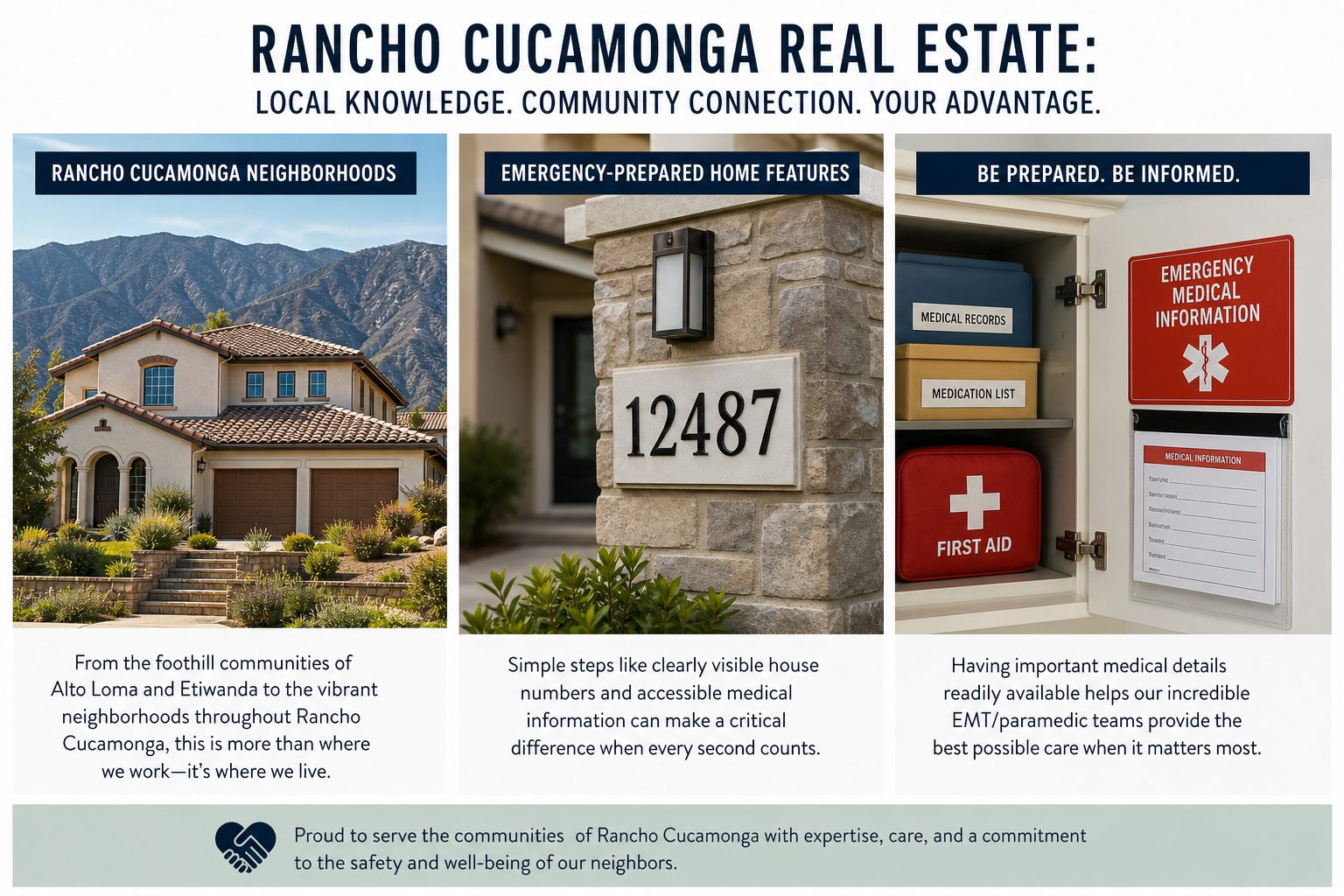
- Make your address visible. Clear, well-lit house numbers save seconds that matter. This is especially important in Rancho Cucamonga’s foothill neighborhoods where driveways can be long and addresses hard to spot at night.
- Have medical information accessible. Keep a list of medications, allergies, and medical conditions posted on the refrigerator or near the front door. If you are caring for an aging parent in an inherited home, this is even more critical.
- Use 911 for emergencies. The nurse line and non-emergency options exist for situations that do not require immediate transport. Reserving 911 for true emergencies keeps ambulances available.
- Know your local fire station. In Rancho Cucamonga, multiple fire stations are distributed across the city. Knowing which one is closest to your home helps set expectations during an emergency.
For the full home-readiness checklist, see Part 1 of this series.
EMS Glossary
- ICEMA: Inland Counties Emergency Medical Agency. The LEMSA overseeing EMS for San Bernardino, Inyo, and Mono counties.
- EOA (Exclusive Operating Area): A geographic zone where only the contracted provider may operate ambulances. San Bernardino County has 19 EOAs out of 26 total operating areas.
- CONFIRE: A Joint Powers Authority providing consolidated fire and EMS dispatch and communications for member agencies in San Bernardino County.
- BLS (Basic Life Support): Stabilizing interventions (CPR, oxygen, AED, splinting) provided by EMTs.
- ALS (Advanced Life Support): Advanced interventions (IVs, cardiac monitoring, medications, advanced airways) provided by paramedics.
- EMT (Emergency Medical Technician): A provider trained at the BLS level.
- Paramedic: A provider with advanced training beyond EMT, authorized for ALS-level care.
- Mutual Aid: An agreement allowing neighboring fire and EMS agencies to provide backup units across jurisdictional boundaries when local resources are committed.
- Interfacility Transport: Moving a patient from one hospital to another for a higher level of care.
- Critical Care Transport: Ambulance transport with specialized equipment and personnel for patients requiring intensive monitoring.
- Medical Dispatch Protocols: Structured protocols used by dispatchers to match the appropriate response type to a 911 call.
- Emergency Communications Nurse System: A system through which a registered nurse assesses certain less-urgent 911 calls and helps coordinate the appropriate level of care.
Frequently Asked Questions
Who runs EMS in San Bernardino County?
ICEMA, the Inland Counties Emergency Medical Agency, is the designated Local Emergency Medical Services Agency for San Bernardino, Inyo, and Mono counties. ICEMA sets policies, credentials providers, and oversees the system. The San Bernardino County Board of Supervisors serves as its governing board. Individual fire departments and contracted ambulance providers handle day-to-day operations under ICEMA’s oversight.
What is ICEMA?
ICEMA stands for the Inland Counties Emergency Medical Agency. It is a joint powers authority that regulates and oversees emergency medical services delivery. Its responsibilities include credentialing EMTs and paramedics, establishing dispatch and patient care policies, designating hospital receiving standards, and ensuring quality assurance across the entire EMS system in the three counties it serves.
What is the difference between an EMT and a paramedic?
An EMT provides Basic Life Support, including CPR, oxygen, AED use, and splinting, after completing roughly 120 to 150 hours of training. A paramedic provides Advanced Life Support, including IV access, cardiac monitoring, medication administration, and advanced airway management, after completing 1,200 to 1,800 hours of additional training beyond EMT certification. Both must be credentialed through ICEMA to work in this system.
What is the difference between BLS and ALS?
BLS, or Basic Life Support, covers the foundational stabilizing interventions that EMTs provide. ALS, or Advanced Life Support, involves the more complex medical interventions that only paramedics are authorized to perform. The dispatch system uses medical protocols to determine which level of response your call requires, matching the right resource to the situation.
Which fire departments in San Bernardino County have their own ambulances?
Based on local field knowledge, fire agencies that operate their own in-house ambulance transport units include San Bernardino County Fire, Rancho Cucamonga Fire, Ontario Fire, Rialto Fire, and the Chino Valley Fire District serving Chino Hills and Chino. These departments handle both first response and patient transport with their own crews and vehicles.
What is mutual aid in EMS?
Mutual aid is a system of agreements that allows neighboring fire and EMS agencies to provide backup units across jurisdictional boundaries. When all of a department’s units are committed on active calls, mutual aid brings in the next available unit from a nearby agency. This is a routine part of daily operations, not a sign of system failure. It is especially important during high call volumes or major incidents.
What does CONFIRE do?
CONFIRE is a Joint Powers Authority that provides consolidated fire and EMS dispatch and communications for member agencies in San Bernardino County. It operates a Command and Control Center with Emergency Medical Protocol Dispatching and an Emergency Communications Nurse System. Since October 1, 2026, CONFIRE EMS and Mobile Health also provides ground ambulance and transport services in the county’s contracted exclusive operating areas.
Why might a fire engine arrive before an ambulance?
Fire stations are distributed throughout neighborhoods for rapid geographic coverage. A fire engine with trained EMTs or paramedics is often the closest unit and can begin assessment and treatment immediately. The ambulance, which handles transport, may be coming from a different staging location. The engine crew starts care so no time is lost while transport is en route.
How does ambulance billing work in San Bernardino County?
The transport provider, whether a city fire department or CONFIRE EMS, bills for ambulance service. San Bernardino County sets rate caps on maximum allowable charges. Your insurer is billed directly if you have Medicare, Medi-Cal, or private insurance. Your out-of-pocket cost depends on your coverage, the level of service, and the type of transport.
How can I help EMS crews respond faster to my home?
Make your house numbers visible and well-lit. Keep a list of household members’ medications, allergies, and medical conditions accessible near the front door. Reserve 911 for genuine emergencies to keep ambulances available. If you are caring for an older family member, consider discussing advance care planning with their physician so crews have clear guidance during a crisis.
The Bottom Line
San Bernardino County’s EMS system is a coordinated network of oversight, dispatch, first response, and transport, designed so that no matter where you live, from the foothill neighborhoods of Rancho Cucamonga to the broader Inland Empire, trained providers respond when you need them. ICEMA sets the standards. CONFIRE dispatches the right resources. Fire departments provide first response and, in many cities, transport through in-house ambulances. CONFIRE EMS and Priority Ambulance cover the contracted exclusive operating areas. And mutual aid ensures coverage holds even when every local unit is committed. Understanding how this system is built helps you prepare your household and make informed decisions about where your family lives.
Have questions about life in the Inland Empire or your next move? Let’s talk. Whether you are buying, selling, or just planning ahead, we will give you honest advice and a clear plan.
Get your free home valuation → soldbyblay.com/home-value Schedule a consultation → soldbyblay.com/contact
Brent Blay | Sold By Blay | Park Regency Realty | DRE #02068178 📞 909-641-8751 | ✉️ brentblay@parkregency.com | soldbyblay.com Your family deserves the best.

Leave a Reply