
What is Mello-Roos, and how does it affect your Etiwanda home?
Mello-Roos is a special tax on your property tax bill that funds the infrastructure and services built into newer Etiwanda communities, and it directly affects what buyers can afford and what sellers must disclose.
In Etiwanda and north Rancho Cucamonga, this is one of the most common questions we get from homeowners thinking about selling: “How does this extra tax line affect what buyers will pay, and what do we have to disclose?” The short answer is that Mello-Roos is a legally required disclosure under California law, it directly impacts a buyer’s monthly payment and loan qualification, and how you price and market your home can either work for you or against you depending on where your CFD stands.
*This article is general information, not legal, tax, or financial advice. Consult a licensed professional. Information and data as of November 2026; figures change regularly.*
Why Mello-Roos Matters Right Now in Rancho Cucamonga
With the 30-year fixed mortgage rate averaging 7.40% for the week ending October 15, 2026, per Freddie Mac, every dollar of a buyer’s monthly payment is under a microscope. A Mello-Roos assessment of roughly $4,000 a year adds close to $333 to the monthly housing cost used in qualifying calculations, which can reduce a buyer’s purchasing power by somewhere in the neighborhood of $50,000 to $60,000, according to Inland Empire lending analysis. Meanwhile, roughly 58.11% of Rancho Cucamonga listings were taking price reductions as of mid-2026. If you are selling an Etiwanda home, understanding exactly how your CFD tax affects buyer math is not optional. It is the difference between pricing strategically and chasing the market down.
Mello-Roos Explained in Plain English for Rancho Cucamonga Homeowners
The Mello-Roos Community Facilities Act of 1982, named after Senator Henry Mello and Assemblyman Mike Roos, created a way for local governments to fund infrastructure and public services in developing communities. Here is the basic idea: when a developer builds a new master-planned community, the roads, sewers, parks, schools, and utilities have to be paid for somehow. A Community Facilities District, or CFD, is formed by a local government agency. Bonds are issued to pay for construction upfront, and those bond costs are repaid over 25 to 40 years through special tax assessments on the properties inside the district.
Once a CFD is approved, a Special Tax Lien is placed against each property, and owners pay a Special Tax each year. That annual tax is separate from your HOA dues and separate from your base Proposition 13 property tax. It appears on a different line of your San Bernardino County tax bill entirely.
What a CFD is *not*: it is not a 1915 Act assessment (a different tool based on lot size or frontage), and it is not an HOA fee (a private corporation governed by CC&Rs). A CFD is a government entity levying a legally authorized special tax. All three can appear on the same property, which is exactly why understanding each line separately matters.
Why So Many Etiwanda Homes Carry CFD Taxes
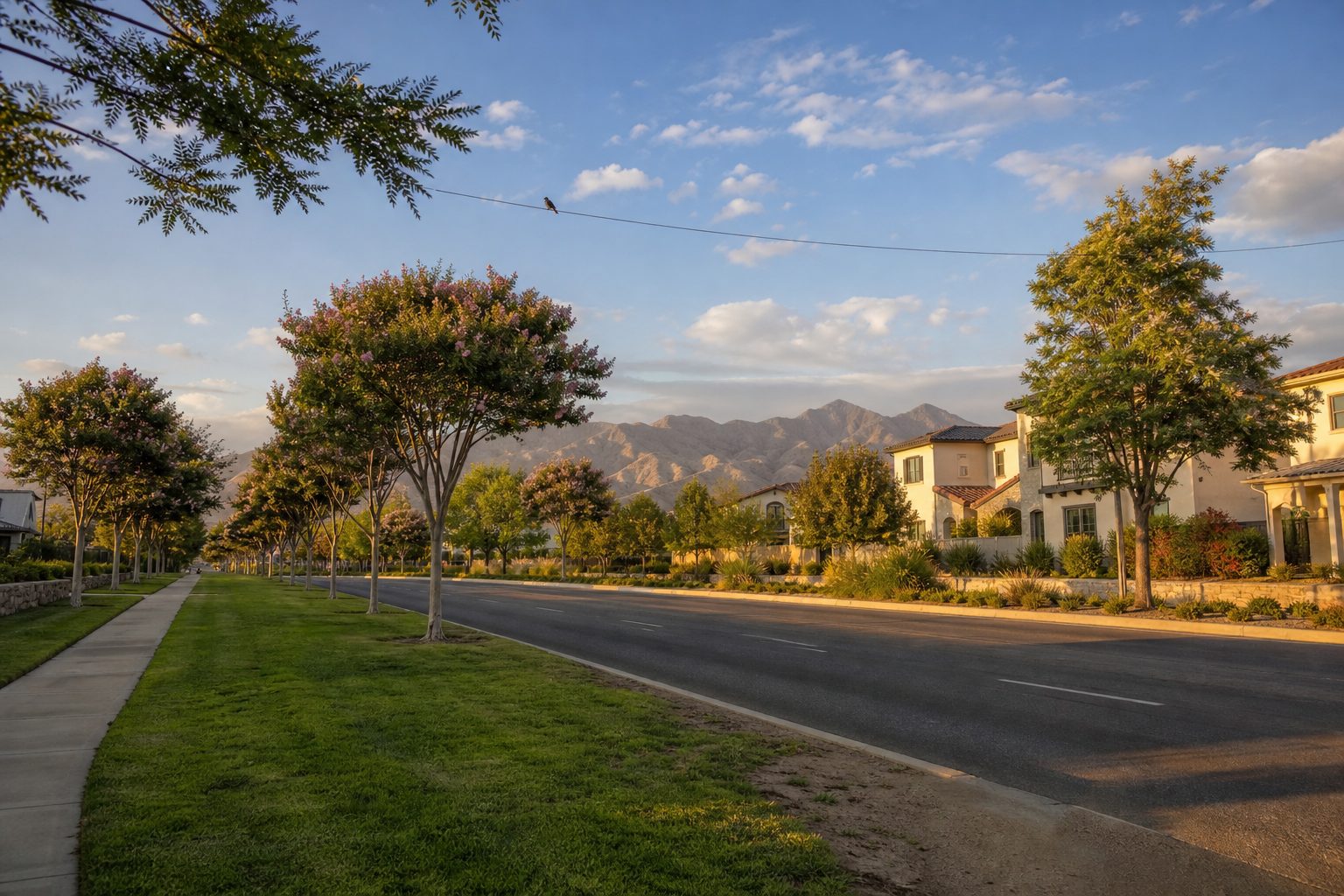
Etiwanda, in the northeast corner of Rancho Cucamonga, was largely undeveloped land until the 1990s and 2000s. Homes in Etiwanda and the Day Creek corridor are frequently ten to twenty years newer than the resale stock in West Rancho Cucamonga or established Alta Loma, with wider streets, updated school facilities, and larger floor plans. That newer infrastructure was financed through CFDs.
Mello-Roos concentrates in the newer development north of Foothill Boulevard, particularly around Day Creek and the Etiwanda area. Multiple agencies formed CFDs to fund this growth:
- CFD 2000-01 (South Etiwanda): Street, sewer, water, storm drain, and landscaping bonds
- CFD 2000-03 (Rancho Summit): Park improvements including equestrian facilities, courts, and ball fields
- CFD 2004-01 (Rancho Etiwanda Estates): Park and equestrian facilities, streets, water and sewer, school facilities, open space
- CFD 2017-01 (North Etiwanda): Ongoing landscaping and parkway maintenance
Here is the layer almost nobody asks about: the city-level CFD is often not the only one attached to a parcel. School districts form their own CFDs too, and they operate independently. In San Bernardino County reporting, active districts tied to the Etiwanda area include CFDs from the Etiwanda School District (Nos. 2001-1, 2004-1, 2004-2, No. 3, No. 4, No. 7, No. 8, and No. 9), the Coyote Canyon Public Facilities CFD of Etiwanda School District, and the Cucamonga School District CFD No. 97-1.
That means a home in Rancho Etiwanda Estates could carry a city infrastructure CFD *and* an Etiwanda School District CFD simultaneously. Neighborhoods like Sheridan Estates, Brentwood, Coral Sky, La Ventana, Andalusia, Carriage Estates, and Etiwanda Estates are all part of this newer Etiwanda growth corridor. Which districts cover a specific address is not something to guess; it must be confirmed on the property’s tax bill or preliminary title report.
By contrast, older tracts in West Rancho Cucamonga near Haven Avenue, South Rancho Cucamonga, and established Alta Loma rarely carry any Mello-Roos at all.
Does Mello-Roos Ever Go Away? Bond CFDs vs. Services CFDs in Etiwanda
Yes, bond-funded CFDs have a defined term, usually 20 to 40 years from issuance. Once the district retires its bonds, the assessment drops off the tax bill. For example, Rancho Cucamonga CFD No. 2000-03 has a final year of 2035, per county reporting.
However, there is a critical caveat. After bonds are paid off, a CFD tax may continue to be collected if part of the assessment funds ongoing maintenance of the facilities. CFD 2017-01 (North Etiwanda), for instance, was formed specifically for ongoing landscaping and parkway maintenance, which means it may not have the same fixed expiration as a bond-funded district. The annual Mello-Roos tax is a fixed dollar amount per parcel (not a percentage of value) that is set when the CFD is formed and may escalate slightly each year per the bond indenture.
So when someone asks, “When does my Mello-Roos end?” the answer depends entirely on which CFD or CFDs cover their parcel. The specific terms are spelled out in the Rate and Method of Apportionment for each district. We always tell clients to request a current payoff quote by calling the CFD administrator, whose number is printed on their property tax bill.
How to Look Up the Mello-Roos on Any Etiwanda Home
You do not need to take anyone’s word for it. Here is how to confirm the CFD details on any Rancho Cucamonga property:
- Start with the tax bill. Your San Bernardino County secured property tax bill lists every special tax and assessment by name and amount. Look for line items labeled “CFD,” “Community Facilities District,” or “Mello-Roos.”
- Check the preliminary title report. During escrow, the title company issues a prelim that lists all liens, including CFD special tax liens, their recording dates, and their amounts.
- Contact the CFD administrator. The phone number for the administering agency is on the tax bill. Call to request a current payoff quote if you want to explore prepaying the balance before listing.
- Review the city’s CFD records. The City of Rancho Cucamonga publishes information on its active Community Facilities Districts. The Etiwanda School District also maintains records on its own CFDs.
If you are buying, always ask your agent to pull the full tax detail on any property you are considering. What matters is not just the current year’s amount, but whether the tax escalates, how many years remain, and whether there is a maintenance component that continues indefinitely.
Mello-Roos vs. HOA Dues vs. Base Property Tax in Rancho Cucamonga
Understanding the difference between these three costs is essential because they are not interchangeable:
Base Property Tax (Proposition 13)
- What it funds: General county and city services, schools, fire, infrastructure
- Who sets it: County Assessor based on assessed value
- How it is calculated: Capped at 1% of assessed value, maximum 2% annual increase
- Does it end? No. Ongoing as long as you own the property
- Rancho Cucamonga effective rate: Approximately 0.71% before special taxes, per cost-of-living data as of 2026
Mello-Roos / CFD Special Tax
- What it funds: Specific infrastructure or services defined at CFD formation (roads, parks, schools, sewer, landscaping)
- Who sets it: The agency that formed the CFD
- How it is calculated: Flat dollar amount per parcel or per square foot, not based on home value
- Does it end? Bond-funded CFDs typically expire in 20 to 40 years. Maintenance CFDs may continue.
- Etiwanda range: In the Inland Empire, CFD assessments typically land between $2,000 and $6,000 a year, per regional analysis, though amounts vary by tract and must be confirmed by address
HOA Dues
- What they fund: Community amenities, landscaping, insurance, reserves, private common areas
- Who sets them: The homeowners association board
- How they are calculated: Monthly or quarterly flat fee, subject to change by board vote
- Do they end? No. Ongoing as long as the HOA exists
- Etiwanda range: Roughly $235 to $380 per month where an HOA applies, per local market data
Put all three together on a home in Day Creek or north Etiwanda that carries both an HOA and a CFD, and a buyer can be looking at $400 to $800 a month in dues and special tax before the mortgage payment even enters the conversation. The effective property tax rate on a Rancho Cucamonga home shifts from a base of about 1.1% to 1.25% up toward 1.5% to 1.8% once the CFD is included.
What Mello-Roos Means for Etiwanda Sellers
Disclosure Is Not Optional
California law requires sellers of property within a Community Facilities District to provide adequate disclosure to buyers that the property carries CFD special taxes. A concern with Mello-Roos financing, noted in state guidance, is the need for proper notice that these charges will be added to the 1% base tax rate. Failure to disclose can expose you to legal liability after closing.
Pricing Strategy Matters More Than You Think
When we help sellers price an Etiwanda home, the Mello-Roos amount is part of the equation. A buyer comparing two homes at the same list price, one with a $3,500 annual CFD and one without, will see a meaningful difference in their monthly payment and the loan amount they qualify for. That is why overpricing a home with a higher CFD is one of the most costly mistakes in this market.
What we tell our clients is this: your Mello-Roos is not a flaw, it is the reason your streets are wider, your parks are maintained, and your schools have the facilities they do. But you must price with the full picture in mind.
Use a Low or Expiring CFD as a Marketing Advantage
If your CFD is approaching its payoff date, or if your annual amount is on the lower end, that is a genuine selling point. It reduces the buyer’s monthly cost relative to comparable homes in adjacent tracts. We make sure that detail is front and center in every marketing conversation.
If you want to explore prepaying a CFD balance before listing to broaden your buyer pool, the process starts with a phone call to the CFD administrator requesting a current payoff quote.
For sellers navigating an inherited Etiwanda property with Mello-Roos, the process involves additional considerations around probate timelines and carrying costs. Heirs and trustees can find more information about selling a home in probate in the Inland Empire.
A Note on Carrying Costs During Probate
It is very important for property owners to pay their tax bill on time, because the CFD has the right, and if bonds are issued, the obligation, to foreclose on a property when special taxes are delinquent for more than 90 days. If you have inherited a home in a CFD area and the estate is going through probate, keeping that tax bill current is not something to put off.
What Buyers Should Know About CFD Taxes in Etiwanda
How Lenders Count Mello-Roos
Your lender adds the monthly Mello-Roos amount directly into your total housing payment when calculating your debt-to-income ratio. This means a $4,000 annual CFD adds roughly $333 per month to your qualifying payment, potentially reducing your purchasing power by $50,000 to $60,000 compared with an identical purchase price in a non-CFD tract.
Before falling in love with a home in Rancho Etiwanda Estates, Coral Sky, or any of the newer communities near Victoria Gardens, ask your lender to run the numbers with the full tax amount included. We always encourage buyers to compare the *total monthly cost* across homes, not just the list price.
Comparing Etiwanda Homes
Homes in ZIP code 91739, which covers much of Etiwanda, carry estimated median values around $1,081,655, per mid-2026 data. As of October 2026, the median price for a single-family home citywide in Rancho Cucamonga is $765,000. The premium you pay for living in Etiwanda’s foothill views, top schools, and new construction luxury is real, but so is the CFD that helped build it. Neither fact makes the area more or less desirable; both simply need to be part of the calculation.
Tax Deductibility
Generally, the portion of Mello-Roos used to repay bonds is not deductible as property tax on your federal return. If a portion of your assessment funds ongoing services like maintenance, that portion may qualify. Consult a tax professional for your specific situation. *This is general information, not tax advice.*
Frequently Asked Questions About Mello-Roos in Etiwanda
What is Mello-Roos tax?
Mello-Roos is a special tax authorized by California’s Community Facilities Act of 1982 (Government Code Section 53311). It is levied on properties within a Community Facilities District to repay bonds that funded infrastructure like roads, sewers, schools, parks, and utilities. It appears as a separate line item on your San Bernardino County property tax bill, billed on top of the standard 1% Proposition 13 rate.
Does Etiwanda have Mello-Roos?
Yes. Mello-Roos is common in Etiwanda and the Day Creek corridor of Rancho Cucamonga. Both the City of Rancho Cucamonga and the Etiwanda School District have formed multiple Community Facilities Districts covering parcels in this area. Whether a specific home carries a CFD, and how much it owes, must be confirmed by address on the property’s tax bill.
How much is Mello-Roos in Rancho Cucamonga?
Amounts vary significantly by tract and by which CFDs cover the parcel. Across the Inland Empire, CFD assessments typically range between $2,000 and $6,000 a year, per regional analysis. Rancho Cucamonga newer northern tracts typically see $1,500 to $2,800 per year, per local market data. The only way to confirm the exact amount is to check the specific property’s tax bill.
When does Mello-Roos end?
Bond-funded CFDs typically expire 20 to 40 years from the date the bonds were issued. For example, Rancho Cucamonga CFD No. 2000-03 has a final year of 2035, per county reporting. However, CFDs formed for ongoing maintenance (like CFD 2017-01 for North Etiwanda landscaping) may not have the same fixed expiration. Check the Rate and Method of Apportionment for your specific district.
Does Mello-Roos go up every year?
The annual amount may escalate slightly each year per the terms set in the bond indenture when the CFD was formed. There is no universal escalator that applies to all CFDs. The specific terms for each district are documented in its Rate and Method of Apportionment, and the amount billed each year appears on the property tax bill.
Is Mello-Roos tax deductible?
Generally, the portion used to repay bonds is not deductible as property tax on your federal return. A portion that funds ongoing services may qualify for deduction. Consult a licensed tax professional for advice on your specific situation. *This is general information, not tax advice.*
Does Mello-Roos lower my home’s value?
Mello-Roos does not inherently lower a home’s value, but it does affect the buyer’s monthly cost and loan qualification. A higher CFD assessment can narrow the pool of buyers who qualify for your home at a given price. Pricing with the full tax picture in mind is essential, which is why working with an agent who understands local CFD dynamics matters.
Do I have to disclose Mello-Roos when I sell?
Yes. California law requires sellers to provide adequate disclosure to buyers that a property is within a Community Facilities District and that CFD special taxes will appear on the tax bill in addition to the base property tax rate. Failure to disclose can create legal liability after closing.
How do I find out if a house has Mello-Roos?
Check the San Bernardino County secured property tax bill for line items labeled “CFD” or “Community Facilities District.” During escrow, the preliminary title report will also list any CFD special tax liens. You can contact the CFD administrator (phone number is on the tax bill) for payoff details and remaining term.
Can you pay off Mello-Roos early?
In many cases, yes. If you want to explore prepaying a CFD balance, the process starts with calling the CFD administrator whose number appears on your property tax bill and requesting a current payoff quote. Prepaying can remove the monthly cost from the buyer’s qualifying calculation, potentially broadening your buyer pool when selling.
The Bottom Line on Etiwanda CFD Taxes
Mello-Roos is not good or bad. It is the financing mechanism that built the infrastructure making Etiwanda one of the most desirable areas in Rancho Cucamonga. As a seller, your job is to disclose it fully, price with it factored in, and use a low or expiring CFD as a competitive advantage. As a buyer, your job is to understand the true monthly cost before you make an offer, not after. Either way, the details live on the tax bill, not in assumptions.
Understanding the 2026 Rancho Cucamonga housing market and how Brightline West and the HART District affect home values can help you contextualize where your home fits in the larger regional landscape.
Have questions about Mello-Roos in Etiwanda or your next move in Rancho Cucamonga? Let’s talk. Whether you are buying, selling, or just planning ahead, we will give you honest advice and a clear plan.
Get your free home valuation at soldbyblay.com/home-value/ Schedule a consultation at soldbyblay.com/contact
Brent Blay | Sold By Blay | Park Regency Realty | DRE #02068178 📞 909-641-8751 | ✉️ brentblay@parkregency.com | soldbyblay.com Your family deserves the best.

Leave a Reply