
What do I need for a jumbo loan in 2026?
If your loan amount exceeds $832,750 in San Bernardino County, you are in jumbo territory, and most lenders will require stronger credit, a larger down payment, lower debt ratios, and significantly more cash reserves than a conforming loan demands. Requirements vary by lender, so getting fully underwritten before you write an offer is the single most important step you can take.
*This article is general information, not lending or financial advice. Requirements vary by lender; consult a licensed mortgage professional. Information and data as of September 2026; figures change regularly.*
Why Jumbo Loan Knowledge Matters Right Now in Rancho Cucamonga
Here is the reality we are seeing on the ground. As of June 2026, the median home sale price in Rancho Cucamonga is approximately $826,000, per recent market data at roughly $408 per square foot. That figure sits just under the 2026 conforming loan limit for San Bernardino County. But once you look north toward the foothill neighborhoods of Alta Loma, Deer Creek, and Etiwanda, where values climb well past $1 million and Deer Creek alone averages roughly $1.67 million, per local market reporting, you quickly cross into jumbo loan territory.
What does that mean practically? It means the buyer pool for your home, or the home you are buying, often depends on jumbo financing. If you are a seller evaluating offers, understanding what a jumbo-qualified buyer looks like helps you pick the strongest deal. If you are a buyer, knowing these requirements months before you start looking keeps you from losing the right home to someone who prepared earlier.
2026 Conforming Loan Limits: Where Jumbo Begins in the Inland Empire
If you are relocating from Orange County or Los Angeles, pay close attention. The conforming loan limit is not the same across every California county.
For 2026, the FHFA set the baseline conforming loan limit for a single-family home at $832,750 in most areas, per the Federal Housing Finance Agency. In designated high-cost counties, the ceiling reaches $1,249,125 for a one-unit property.
Here is how that breaks down for the three counties most relevant to Inland Empire buyers:
- San Bernardino County: $832,750 (Baseline)
- Los Angeles County: $1,249,125 (High-Cost)
- Orange County: $1,249,125 (High-Cost)
*Source: Federal Housing Finance Agency (FHFA), effective January 1, 2026.*
What this means if you are moving east from Orange County or L.A.: You may be accustomed to a $1,249,125 conforming ceiling. When you cross into San Bernardino County, that ceiling drops by more than $416,000. A $950,000 loan that would be a standard conforming loan in Irvine or Pasadena becomes a jumbo loan the moment you purchase in Rancho Cucamonga. That changes your documentation requirements, your reserve requirements, and potentially your interest rate, even if your financial profile has not changed at all.
Typical 2026 Jumbo Loan Requirements in Rancho Cucamonga
Jumbo loans are underwritten by individual lenders who keep the loans on their own books. They are not sold to Fannie Mae or Freddie Mac, which is precisely why standards vary from lender to lender and why shopping matters more than it does on a conforming loan.
Below are the typical ranges across lenders in 2026. Present these to your mortgage professional as starting benchmarks, not guarantees.
Credit Score
- Minimum: 700 (most lenders); 720 or higher preferred for the best rates
- Some lenders accept 680 with strong compensating factors such as a large down payment and significant reserves
- Scores above 740 typically unlock the most competitive jumbo pricing
- Per multiple lender guidelines as of 2026, some lenders set the bar at 740+ for loan amounts above $1.5 million
Debt-to-Income Ratio (DTI)
- Maximum: 43% at most lenders; many prefer to see 36% or lower
- A borrower with a 760 score and two years of reserves may qualify at a DTI up to 45%, according to published lender guidelines as of 2026
- Front-end ratio (housing costs only) is typically capped at 28% to 31%
Down Payment
- Typical minimum: 10% to 20% for loan amounts up to roughly $1.5 million
- Loans above $1.5 million: 15% to 25% is common
- 20% is the sweet spot that avoids private mortgage insurance and accesses the best pricing
Cash Reserves
- Standard jumbo (up to roughly $2.5 million): 6 to 12 months of full mortgage payments (principal, interest, taxes, insurance) in liquid assets after closing
- Large jumbo ($2.5 million to $5 million): 12 to 18 months
- Super jumbo ($5 million and above): 12 to 24 months or more
- These reserves must remain in your accounts after your down payment and closing costs are paid
*Sources: Amerisave, Future Loans, The Mortgage Phoenix Group, The Advantage Lending, reflecting multiple lender guidelines as of 2026. Verify current requirements with a licensed mortgage professional.*
What does all of this look like in real dollars? Let us say you are purchasing a home at $1,100,000 in Alta Loma with 20% down. Your loan amount would be $880,000. At six months of reserves, you might need roughly $30,000 to $35,000 in liquid assets sitting in your accounts after you have already paid your down payment of $220,000 and your closing costs. That is a significant amount of capital to have verified and documented before you even write an offer.
The Appraisal Factor for Rancho Cucamonga Luxury Properties
Appraisals on jumbo-financed properties carry more weight and more complexity than on standard conforming deals. Here is why that matters in Rancho Cucamonga specifically.
Second Appraisals
Many lenders order a second, independent appraisal once loan amounts reach certain thresholds, commonly in the $1.5 million to $2 million range, though lender policies vary widely. When two appraisals produce different values, the lender typically uses the lower of the two. That is not necessarily a deal-killer, but it is something to plan for.
Unique Luxury Properties Are Harder to Appraise
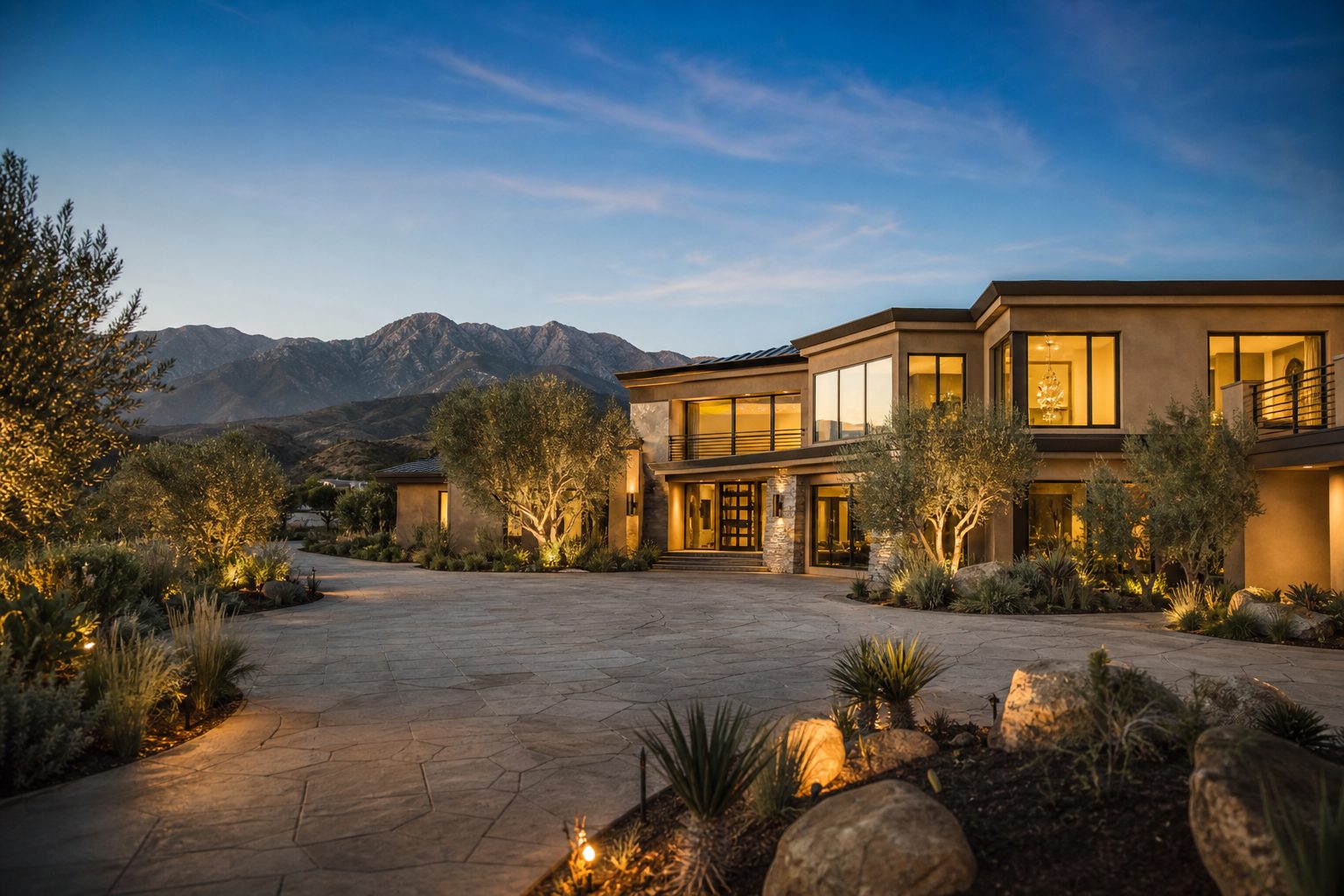
In Alta Loma, Deer Creek, and the Etiwanda foothill zones, custom estate homes on half-acre to one-acre lots with mountain views, equestrian facilities, or resort-style pools often have limited comparable sales. Appraisers must stretch for comps, sometimes going back further in time or wider in geography than either party would prefer. Price per square foot across Rancho Cucamonga clusters in the low $400s per square foot, per recent market data, but the foothill areas regularly post higher medians due to lot size, views, and custom finishes, making appraisal comparisons trickier.
Appraisal Gaps
When a property appraises below the contract price, jumbo buyers have fewer bailout options than conforming buyers. Most jumbo lenders will not lend above appraised value. Your options include:
- Negotiating a price reduction with the seller
- Bringing additional cash to cover the gap
- Including an appraisal gap coverage clause in your offer upfront
Special Situations: Self-Employed, Stock Compensation, and Asset-Rich Buyers
Not everyone qualifies with a straightforward W-2 and pay stub. If your income picture is more complex, you still have options, but the documentation demands increase.
Self-Employed and Business-Owner Income
- Expect to provide two full years of personal and business tax returns, year-to-date profit and loss statements, and sometimes a CPA letter
- Lenders typically average your net income over 24 months; if your income declined year-over-year, that average may not work in your favor
- Bank-statement loan programs allow qualification based on 12 to 24 months of business or personal bank deposits instead of tax returns; these carry higher rates but solve a real problem for business owners whose write-offs reduce taxable income well below actual cash flow
Stock Compensation, RSUs, and Bonus Income
- Restricted stock units (RSUs) and bonuses are generally accepted if you can document a two-year history of receiving them
- Lenders usually average the past two years and may discount the figure by 25% or more for volatility
- Unvested RSUs are typically not counted
Asset-Depletion and Pledged-Asset Loans
- Asset-depletion loans allow you to qualify using your liquid asset portfolio (investment accounts, retirement accounts) divided over the loan term to create a “virtual income” stream
- Pledged-asset loans let you pledge investments as collateral in lieu of a traditional down payment, keeping your portfolio intact
- Both are portfolio products with limited availability; not every lender offers them
Gift Funds
- Jumbo lenders are often more restrictive about gift funds than conforming lenders
- Many require that your own funds cover a minimum percentage of the down payment (commonly 5% to 10% of the purchase price from your own verified accounts)
- Gift funds typically require a signed gift letter, proof of the donor’s ability to give, and a paper trail showing the transfer
Asset Seasoning and Large Deposits
- Most jumbo lenders require that funds be “seasoned” in your accounts for 60 to 90 days before closing
- Any large deposit (generally anything above 50% of your monthly income) will require a full paper trail and letter of explanation
- If you recently sold another property, received an inheritance, or liquidated investments, have documentation ready before you apply
Alternatives to a Single Jumbo Loan in Rancho Cucamonga
A jumbo mortgage is not the only path. Depending on your situation, one of these structures might save you money or simplify qualification.
Larger Down Payment to Stay Conforming
If you are purchasing at $1,000,000 and can put down roughly 17% or more, your loan amount drops below the $832,750 conforming limit. You gain access to conforming rates, easier qualification, and a broader lender market. For many Rancho Cucamonga buyers in the $900,000 to $1,050,000 range, this math is worth running.
Piggyback Loan Structure (80/10/10)
You take a conforming first mortgage at 80% of the purchase price, a home equity line or second mortgage at 10%, and put 10% down. The first mortgage stays conforming; the second is smaller and sometimes easier to obtain than a full jumbo. The combined rate on both loans may or may not beat a single jumbo, so run the numbers both ways with your lender.
Jumbo vs. Conforming Rates
As of the week of February 12, 2026, Freddie Mac’s Primary Mortgage Market Survey showed the 30-year conforming fixed rate at around 6.09%. Jumbo rates in 2026 have generally run roughly 0.25% to 0.50% above conforming rates, per industry reporting. Adjustable-rate jumbo products (5/1 ARM, 7/1 ARM) may offer lower initial rates if you plan to sell or refinance within the fixed-rate period.
*Rate source: Freddie Mac Primary Mortgage Market Survey, week of February 12, 2026. Rates change daily; verify with your lender.*
Your Jumbo Loan Document Checklist and Timeline
Getting your paperwork together early is not optional with a jumbo loan. It is the difference between a strong offer and a weak one.
Documents to Gather Before You Apply
- Two years of federal tax returns (personal and business, if applicable)
- Two years of W-2s, 1099s, or K-1s
- Two to three months of bank statements (all accounts)
- Two to three months of investment and retirement account statements
- Most recent 30 days of pay stubs
- Letter of explanation for any large deposits, credit inquiries, or employment gaps
- If self-employed: year-to-date profit and loss statement, business license, CPA letter
Pre-Approval vs. Pre-Qualification vs. Full Underwriting
- Pre-qualification: a quick estimate based on what you tell a lender verbally; carries almost no weight with sellers
- Pre-approval: the lender pulls credit and reviews documents; stronger, but not final
- Full underwriting upfront: the lender completes the entire underwriting review before you make an offer, so the only remaining condition is the appraisal and title; this is the gold standard for jumbo-financed offers, and what we tell our clients to pursue
Typical Timeline
- Gathering documents: 1 to 2 weeks
- Full underwriting review: 2 to 4 weeks
- Total from application to closing: 30 to 45 days on average, but faster if you start the underwriting process before finding a property
Buying Up While You Still Own Your Current Rancho Cucamonga Home
This is one of the most common scenarios we work through with families in Rancho Cucamonga. You own a home, you want to buy something larger or in a different neighborhood, and you are not sure how to qualify for a jumbo loan while your current mortgage is still active.
Here is what you need to know:
- Debt-to-income calculation: your current mortgage payment counts against your DTI unless you can prove the property is under contract to sell or has been rented for 12 or more months with documented lease income
- Reserves: you may need reserves for both properties, not just the new one
- Bridge financing and HELOCs: these can help you access equity in your current home for the down payment on the next one, but they add complexity and cost
- Selling first vs. buying first: the right sequence depends on your financial picture, the market conditions, and your risk tolerance
If you are planning to upsize and need to understand what your current Rancho Cucamonga home is worth before you start the jumbo qualification process, that equity number is the foundation of the entire plan.
With homes in Rancho Cucamonga selling at a median sale-to-list-price ratio of 99.24%, per recent data, and 33.96% of homes selling above list price, your equity position may be stronger than you think, but you need an accurate number, not a guess.
What Rancho Cucamonga Luxury Sellers Should Look for in a Jumbo-Financed Offer
If you are selling a home priced above the conforming limit in Rancho Cucamonga, Alta Loma, or Etiwanda, here is what to evaluate when a jumbo-financed offer comes in.
Lender Strength and Underwriting Status
Not all pre-approval letters are created equal. A buyer who is fully underwritten by a lender experienced in jumbo products is dramatically more likely to close than one who has only been pre-qualified. Ask to see the lender’s name and whether the file has been through full underwriting.
Appraisal Gap Coverage
With unique luxury properties in the foothills, appraisal risk is real. The strongest jumbo-financed offers include a written commitment from the buyer to cover a specific dollar amount if the appraisal comes in below the contract price.
Reserves After Closing
A buyer with 12 months of reserves after closing is far less likely to encounter last-minute underwriting issues than one scraping together the minimum six months. Ask your agent to verify reserve strength.
Closing Timeline
Jumbo loans can take 35 to 45 days to close, and sometimes longer for complex income situations. If your timeline is tight, factor that into your decision.
As of January 2026, the Rancho Cucamonga housing market had a moderate 1.41-month supply of inventory, per local market reporting, and properties were selling for 98.05% of asking price. That means you have some leverage as a seller, but choosing the right offer still matters more than choosing the highest number.
Frequently Asked Questions
What is the 2026 conforming loan limit in San Bernardino County?
The 2026 conforming loan limit for a single-unit property in San Bernardino County is $832,750, as set by the Federal Housing Finance Agency (FHFA) effective January 1, 2026. This is the baseline limit used in most areas. In designated high-cost counties like Los Angeles and Orange County, the limit reaches $1,249,125. Any loan amount exceeding the county's conforming limit is considered a jumbo loan and is subject to more stringent underwriting requirements.
What credit score do I need for a jumbo loan?
The minimum credit score for most jumbo lenders is 700, though 720 or higher is preferred for better rates. Some lenders may accept scores as low as 680 if you have strong compensating factors such as a large down payment and significant cash reserves. Scores above 740 typically unlock the most competitive jumbo pricing. For loan amounts above $1.5 million, some lenders set the minimum at 740. It is important to consult with your mortgage professional about your specific score and financial situation.
How much cash reserves do I need for a jumbo loan?
Cash reserve requirements depend on the loan amount. For a standard jumbo loan (up to roughly $2.5 million), lenders typically require 6 to 12 months of full mortgage payments (principal, interest, taxes, insurance) in liquid assets remaining after closing. For large jumbo loans ($2.5 million to $5 million), expect 12 to 18 months of reserves. Super jumbo loans ($5 million and above) may require 12 to 24 months or more. These reserves must remain in your accounts after you have paid your down payment and closing costs.
What is the minimum down payment for a jumbo loan?
The typical minimum down payment for jumbo loans is 10% to 20% for loan amounts up to roughly $1.5 million. For loans above $1.5 million, lenders commonly require 15% to 25% down. A 20% down payment is considered the sweet spot because it allows you to avoid private mortgage insurance (PMI) and often qualifies you for the best pricing available. However, down payment requirements vary by lender, so it is worth shopping with multiple lenders to find the best terms for your situation.
What debt-to-income ratio do I need for a jumbo loan?
The maximum debt-to-income (DTI) ratio for most jumbo lenders is 43%, though many prefer to see 36% or lower. Some lenders will allow a DTI up to 45% if you have a high credit score (around 760) and two years of cash reserves. Your front-end ratio (housing costs only) is typically capped at 28% to 31%. DTI requirements vary by lender, so verify the specific thresholds with your mortgage professional based on your financial profile.
Can I get a jumbo loan if I am self-employed?
Yes, self-employed borrowers can qualify for jumbo loans, but documentation requirements are stricter. Expect to provide two full years of personal and business tax returns, year-to-date profit and loss statements, and sometimes a CPA letter. Lenders typically average your net income over 24 months; if your income declined year-over-year, that average may affect your qualification. Bank-statement loan programs offer an alternative, allowing you to qualify based on 12 to 24 months of business or personal bank deposits instead of tax returns, though these programs carry higher interest rates.
What documents do I need to gather before applying for a jumbo loan?
Before applying for a jumbo loan, gather two years of federal tax returns (personal and business if applicable), two years of W-2s, 1099s, or K-1s, two to three months of bank statements for all accounts, two to three months of investment and retirement account statements, the most recent 30 days of pay stubs, and a letter of explanation for any large deposits, credit inquiries, or employment gaps. If you are self-employed, also prepare a year-to-date profit and loss statement, business license, and a CPA letter. Having these documents ready before you apply accelerates the underwriting process.
What is the difference between pre-qualification, pre-approval, and full underwriting?
Pre-qualification is a quick estimate based on verbal information you provide to a lender; it carries almost no weight with sellers. Pre-approval occurs when the lender pulls your credit and reviews documents, providing stronger evidence of your buying power, though it is not final. Full underwriting is when the lender completes the entire underwriting review before you make an offer, meaning the only remaining conditions are typically the appraisal and title review. For jumbo-financed offers, full underwriting upfront is the gold standard and what most luxury sellers expect to see.
How long does it take to close on a jumbo loan?
The typical timeline from application to closing on a jumbo loan is 30 to 45 days on average, though it can be faster if you start the full underwriting process before finding a property. Gathering documents typically takes 1 to 2 weeks, and full underwriting review takes 2 to 4 weeks. Complex income situations, such as self-employment or multiple income sources, may extend the timeline. If your sale timeline is tight, factor in the longer jumbo closing window when planning your offer.
How do jumbo loan rates compare to conforming loan rates?
As of the week of February 12, 2026, Freddie Mac's Primary Mortgage Market Survey showed the 30-year conforming fixed rate at around 6.09%. Jumbo rates in 2026 have generally run roughly 0.25% to 0.50% above conforming rates. Some adjustable-rate jumbo products, such as 5/1 ARMs or 7/1 ARMs, may offer lower initial rates if you plan to sell or refinance within the fixed-rate period. Rates change daily, so verify current jumbo rates with your lender for an accurate comparison.
The Bottom Line
If you are navigating the jumbo loan process in Rancho Cucamonga, the path forward starts with getting your documents together, understanding where your equity stands, and pursuing full underwriting before you make an offer. Whether you are buying up, selling a luxury property, or deciding between a jumbo and a conforming structure, the details in each of these categories matter more than most buyers expect. We are happy to walk through any of these scenarios with you so you can move forward with clarity and confidence.
Questions about your own situation? Call or text Brent Blay at 909-641-8751 or visit soldbyblay.com.
Brent Blay | Sold By Blay at Park Regency Realty | CalDRE #02068178
Your family deserves the best.

Leave a Reply