


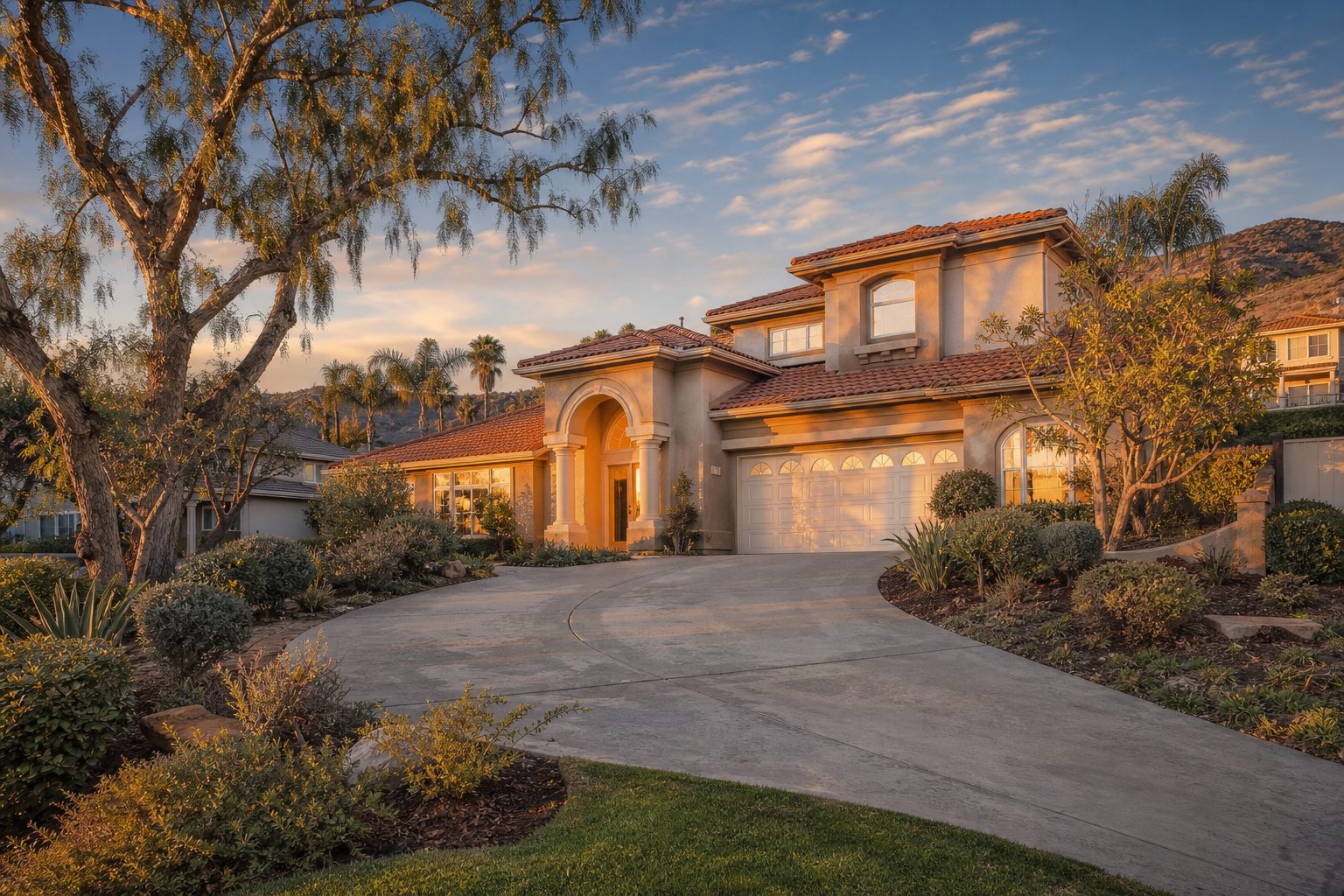
When one sibling wants to keep an inherited home and the others want their share, how do you divide the property fairly without tearing the family apart?
In California, the smoothest path is usually for the trust or estate to transfer the home to the sibling who wants it and equalize the others with remaining assets or a trust-level loan, ideally before the home is formally distributed to anyone. Done correctly, this can also preserve your parents’ low property tax base under Proposition 19.
> Disclaimer: This article is general information, not legal or tax advice. Inheritance, trust, and Prop 19 rules are complex and fact-specific. Please consult a California estate or probate attorney and a CPA before making any decisions about an inherited home.
Why This Matters Right Now in Rancho Cucamonga
Rancho Cucamonga’s housing values make this conversation especially high stakes. According to Orchard data, the median home sale price in Rancho Cucamonga was approximately $765,000 in the most recent 30-day period as of mid-2026. In the foothill neighborhoods of Alta Loma and Etiwanda, values run significantly higher, and luxury communities like Deer Creek and Haven View Estates sit well above the citywide median.
What does that mean for your family? If you and your siblings just inherited your parents’ home, you could be looking at a property worth anywhere from the high $700,000s to well over $1.5 million, depending on the neighborhood. That is a substantial asset, and getting the division right is not optional. With roughly 14% of Rancho Cucamonga’s population over age 65, according to demographic data from World Population Review, more families in our community are facing this exact conversation every year.
First Questions to Answer Before Choosing a Path
Before anyone hires an attorney or calls a lender, your family needs clarity on a few foundational facts. What we tell families at Sold By Blay is to answer these questions first, because the answers determine which options are actually available to you:
- Where is the home titled right now? Is it still held in your parents’ trust, going through probate at San Bernardino County Superior Court, or has it already been deeded to you and your siblings?
- What does the trust or will say? Does it give any sibling a right of first refusal, an option to purchase, or authority for non-pro rata distributions?
- Will the sibling keeping it live there as their primary residence? This is the threshold question for Prop 19 protection.
- What is the home’s current fair market value, and what was your parents’ assessed value? The gap between these two numbers drives the tax conversation.
- Is there an existing mortgage? If so, it must be addressed in any buyout or distribution.
- Can the keeping sibling actually afford the buyout and ongoing costs? Mortgage payments, property taxes, insurance, and maintenance on a Rancho Cucamonga home are not trivial.
Getting these answers early prevents months of confusion and, honestly, prevents the kind of family tension that can become permanent.
Step One: Get an Accurate, Documented Valuation in Rancho Cucamonga
Everything flows from an honest number. Disagreements about what the home is worth are one of the most common reasons sibling negotiations fall apart.
You have two main tools:
- Professional appraisal. A licensed California appraiser provides a defensible, court-quality opinion of value. For inherited homes, the appraisal is typically anchored to the date of death, which establishes your stepped-up cost basis for federal capital gains tax purposes under IRC Section 1014. Your CPA can walk you through how this works.
- Broker Opinion of Value. A written comparative market analysis from a Rancho Cucamonga real estate agent who knows the difference between a standard central tract home and a custom hillside property in Alta Loma can serve as a useful data point alongside a formal appraisal.
Why does neighborhood-level precision matter so much here? Because Rancho Cucamonga is really a collection of distinct neighborhoods at very different price points. According to Orchard, the median price per square foot was approximately $426.79 in the most recent 30-day period as of mid-2026, but northern foothill zones like Alta Loma and Etiwanda typically post higher medians, while parts of the southwest and central pockets run lower. An automated estimate that treats all of Rancho Cucamonga the same will miss the mark.
Option 1: Keep the Home in the Trust or Estate and Equalize
This is frequently the most tax-advantaged and family-friendly approach. But it only works before the home is distributed out of the trust or estate, so timing is critical.
How Non-Pro Rata Distribution Works
California law generally allows a trustee to distribute trust assets on a non-pro rata basis, unless the trust says otherwise. That means instead of giving each sibling a proportional slice of every asset, the trustee can give Sibling A the house and equalize Siblings B and C with other assets (bank accounts, investment accounts, life insurance proceeds) of equivalent value.
When Other Assets Are Not Enough
If the trust does not hold enough liquid assets to equalize, the trustee can take out a loan against the property at the trust or estate level and distribute those proceeds to the other siblings. According to California State Board of Equalization guidance, for the transfer to qualify as a parent-to-child transfer for Prop 19 purposes, the loan should be made to the trust or estate itself. The child receiving the home generally should not be the borrower, lender, or guarantor. This is a nuanced area where your estate attorney needs to be in the driver’s seat.
Why Timing Matters
Once the home has been distributed and titled to all siblings as tenants in common, a non-pro rata distribution is no longer possible. At that point, any buyout becomes a sibling-to-sibling transfer, and the Prop 19 property tax protection largely disappears. The purchased portion would be reassessed at current market value.
Option 2: Sibling Buyout After Distribution
If the home has already been distributed to multiple siblings on title, or if a trust-level approach is not available, the sibling who wants to keep it can still buy out the others’ shares at fair market value.
How the Financing Works
The buying sibling typically uses a cash-out refinance, a home equity loan, or a new purchase mortgage. As of the week of February 12, 2026, the 30-year fixed mortgage rate was approximately 6.09%, according to Freddie Mac’s Primary Mortgage Market Survey as cited by industry reporting. That is lower than the 2024 to 2025 peaks, which has made financing somewhat more accessible.
The Property Tax Tradeoff
Here is the key difference from Option 1. When a sibling buys another sibling’s share after the property has been distributed, that purchased portion is generally treated as a sibling-to-sibling transfer, not a parent-to-child transfer. The result is that the acquired share gets reassessed at current market value. If your parents bought the home decades ago with an assessed value far below today’s market, this reassessment can mean a significant increase in annual property taxes.
This is exactly why what we tell families is to explore the trust-level equalization path first, before anyone takes title.
Option 3: Sell the Rancho Cucamonga Home and Split the Proceeds
Sometimes selling is the fairest and simplest path, especially when no sibling can afford the buyout, the home needs significant work, or the family just needs a clean break.
The Stepped-Up Basis Advantage
All siblings receive a stepped-up cost basis to the home’s fair market value at the date of death, under IRC Section 1014. That means if you sell the home at or near that value, capital gains taxes can be minimal. This is one of the most significant tax benefits in inheritance, and it applies whether you sell through a trust sale, a probate sale, or after distribution.
Preparing an Inherited Home for Sale
Many inherited homes in Rancho Cucamonga were built during the city’s major growth period in the 1980s and 1990s, and they may need updates. In the current balanced market, per Orchard data as of mid-2026, homes in Rancho Cucamonga are selling in a median of 25 days, but pricing and presentation matter more than ever. Homes that sit on the market can go stale, while well-priced, well-presented homes still sell efficiently.
Option 4: Co-Own the Property or Rent It Out
Some families decide to keep the home together as a rental property or hold it for future appreciation. This can work, but it requires a written co-ownership agreement that covers who pays for maintenance, insurance, and property taxes; how rental income is split; what happens when one sibling wants out; and a buyout formula.
Be aware that if no sibling uses the home as their primary residence, the property will be reassessed at current market value under Prop 19 rules. According to Orchard, the average monthly rent in Rancho Cucamonga is approximately $4,456, which may or may not cover the carrying costs depending on your parents’ remaining mortgage and the reassessed property taxes.
When Siblings Cannot Agree: Mediation and Partition in California
We always encourage families to try mediation first. A neutral third-party mediator can often help siblings find common ground without the cost, time, and relationship damage of litigation.
If mediation fails, any co-owner in California has a legal right to file a partition action. For partition actions filed on or after January 1, 2023, the Partition of Real Property Act (California Code of Civil Procedure sections 874.311 through 874.323, enacted by AB 2245) applies to tenancy-in-common property without a binding partition agreement. Under this act, the court orders an appraisal by a disinterested California-licensed appraiser (unless the co-owners agree on a value), and co-owners who did not request the sale get a right to buy out the petitioning co-owner’s share at appraised value before a forced sale can proceed.
Partition is a last resort. It is expensive, it takes time, and it almost always damages family relationships. But it exists as a safety valve when no agreement is possible.
Prop 19: The Property Tax Piece Rancho Cucamonga Families Often Miss
California’s Proposition 19, effective February 16, 2021, significantly changed the rules for inherited property. Here is what you need to know:
- The parent-to-child exclusion now applies only to a family home (or family farm) that the child makes their principal residence within one year of transfer
- The child must file for the homeowners’ or disabled veterans’ exemption and submit form BOE-19-P to the San Bernardino County Assessor
- The exclusion is capped: the home’s current market value must not exceed the parent’s factored base year value plus an inflation-adjusted amount ($1,044,586 for transfers between February 16, 2025 and February 15, 2027, per the California State Board of Equalization). Any value above that cap is added to the taxable assessed value
- If siblings who do not live in the home remain on title, their shares can be reassessed
Rules and amounts are as of September 2026. The Prop 19 exclusion amount adjusts every two years.
Your Rancho Cucamonga Options at a Glance
Here is a quick comparison of each path:
- Option 1: Non-Pro Rata Trust Distribution with Equalization. Can preserve parents’ tax base (if requirements are met). Moderate speed, depending on trust administration. Lowest cost in most cases. Best for family harmony. Ideal when the trust holds enough assets to equalize or a trust-level loan is feasible, and the keeping sibling will use the home as a primary residence.
- Option 2: Sibling Buyout After Distribution. Purchased share is typically reassessed, so parents’ tax base is partially lost. Moderate speed, depending on financing. Moderate cost (appraisal, refinancing, transfer taxes). Good for family harmony if everyone agrees on value. Ideal when the home is already on title with siblings but one clearly wants to keep it.
- Option 3: Sell and Split Proceeds. Parents’ tax base is not relevant (new buyer is reassessed). Moderate speed (homes in Rancho Cucamonga are selling in a median of 25 days as of mid-2026, per Orchard). Standard selling costs. Can be good or stressful for family harmony depending on communication. Ideal when no sibling can afford the buyout or when a clean break is best.
- Option 4: Co-Own or Rent. Property is reassessed if no one lives there as a primary residence. No immediate action needed. Ongoing carrying costs shared. Can strain relationships over time without a written agreement. Ideal when all siblings agree and want to hold for appreciation or rental income.
- Option 5: Partition Action. Parents’ tax base is lost. Slow (litigation timeline). Highest cost (legal fees, court costs). Most damaging to family harmony. Only for situations where no agreement is possible.
How a Probate and Trust Real Estate Specialist Helps in Rancho Cucamonga
This is where we come in. When a family is trying to divide an inherited home fairly, the real estate side of the equation touches everything: the valuation that drives the buyout math, the market analysis that determines whether selling a home in probate makes sense, the preparation of the home if it does go on the market, and the coordination with the family’s attorney and CPA on timing, Prop 19 filings, and trust-level transactions.
At Sold By Blay, we specialize in probate and trust real estate across Rancho Cucamonga, Alta Loma, Etiwanda with foothill views and top schools, Upland, Fontana, Ontario, and the broader Inland Empire. We are not attorneys or CPAs, but we work alongside your legal and tax team to make sure the real estate decisions support the overall plan. We provide neutral pricing opinions that help siblings agree on value. We manage communication with multiple heirs, including those who live out of state. And when the decision is to sell, we handle everything from preparing the home to closing.
Frequently Asked Questions
How do you split an inherited house between siblings?
The most common approaches are a non-pro rata distribution through the trust or estate (one sibling gets the house, others get equivalent assets), a sibling buyout at fair market value, selling the home and splitting proceeds, or co-owning the property. The best option depends on your trust or will language, financing ability, and whether anyone plans to live in the home.
Can one sibling buy out the others on an inherited house in California?
Yes. The buying sibling pays the others their proportional share of the home’s fair market value, typically financed through a cash-out refinance or new mortgage. A professional appraisal is essential to establish the value. Be aware that after distribution, the purchased share is generally reassessed for property tax purposes.
Will buying out my siblings trigger a property tax reassessment in Rancho Cucamonga?
It depends on timing. If the buyout happens at the trust or estate level before distribution, it may qualify as a parent-to-child transfer under Prop 19 (with conditions). If it happens after siblings are already on title, the purchased shares are generally reassessed at current market value, per California State Board of Equalization guidance.
What is a non-pro rata distribution?
It means the trustee distributes different assets to different beneficiaries rather than giving everyone a proportional slice of each asset. One sibling receives the home while others receive cash, investments, or loan proceeds of equal value. California law generally permits this unless the trust document says otherwise.
Can a sibling force the sale of an inherited house in California?
Yes. Any co-owner can file a partition action in court. Under the Partition of Real Property Act (effective for actions filed on or after January 1, 2023), the court orders an appraisal, and non-petitioning co-owners get a right to buy out the petitioning co-owner’s share before a forced sale is ordered. Partition is costly and should be a last resort.
What is the Partition of Real Property Act in California?
Enacted by AB 2245 and codified in Code of Civil Procedure sections 874.311 through 874.323, it applies to partition actions filed on or after January 1, 2023 involving tenancy-in-common property without a binding partition agreement. It requires a court-ordered appraisal, gives co-owners buyout rights, and favors partition in kind over forced sale when feasible.
Do I pay capital gains tax if we sell an inherited house?
All heirs receive a stepped-up cost basis to the home’s fair market value at the date of

Leave a Reply