

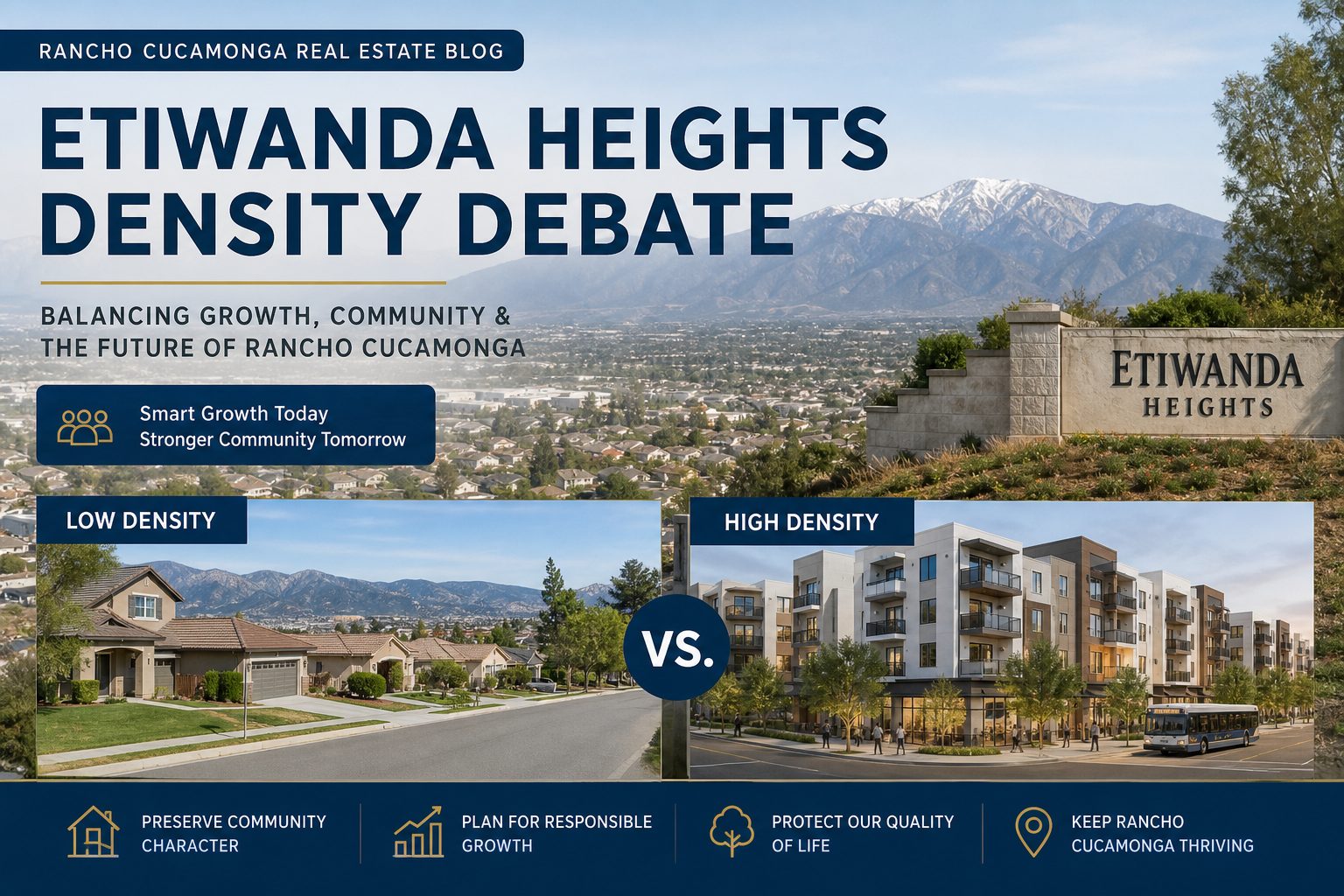
What is the Etiwanda Heights density debate, and how does it affect homeowners in Rancho Cucamonga?
The Rancho Cucamonga City Council unanimously approved an amendment to the Etiwanda Heights Neighborhood and Conservation Plan in January 2026, increasing allowable density in the roughly 790-acre Neighborhood Area. A coalition of residents has filed a legal challenge, and as of September 2026, that case remains active.
Why the Etiwanda Heights Amendment Matters Right Now in Rancho Cucamonga
If you own property anywhere near the Etiwanda foothills, or if you are buying, selling, or inheriting a home in northern Rancho Cucamonga, this debate directly affects your decisions. The amendment changes the density framework for hundreds of acres in the foothills north of Banyan Avenue, near Milliken Avenue and Wilson Avenue, close to Los Osos High School. Whether you are evaluating what your home is worth in Rancho Cucamonga, planning a sale tied to a probate or trust, or considering a purchase in the Etiwanda area, you need clear facts, not speculation. That is what we are here to provide.
*Disclaimer: This post is informational only and is not legal advice. The situation is ongoing and details may change. Please verify the current status before making any decisions.*
What Is the Etiwanda Heights Neighborhood and Conservation Plan?
The EHNCP is a specific plan that covers the foothills north of existing Etiwanda neighborhoods in Rancho Cucamonga. The City adopted it in 2019 with stated goals of preserving views of the San Gabriel foothills and mountains, conserving rural open space and habitat resources to the extent feasible, securing recreational access, and providing new neighborhoods reflecting the city’s heritage, according to the CEQA filing (SCH #2017091027).
The plan covers two areas: a roughly 790-acre Neighborhood Area and a much larger 3,603-acre conservation zone. In 2019, the City Council approved approximately 2,700 to 3,000 homes on the Neighborhood Area, per city records.
For residents who bought or built in surrounding Etiwanda and Alta Loma neighborhoods during that period, the original plan and what it implied about the future character of the foothills north of Banyan Avenue was a factor in their decision. Many understood it as a commitment to low-density, single-family development. The 2026 amendment is at the center of a dispute over whether that understanding still holds.
So what actually changed? Let us walk through the specifics.
What the Rancho Cucamonga EHNCP Amendment Changes
The amendment aligns the Specific Plan with the maximum residential density established under the City’s 2021 General Plan Update. The land is designated as Traditional Neighborhood in the General Plan, which permits a gross maximum of up to 8 dwelling units per acre, according to the CEQA filing. The amendment also introduces new building types, including duplexes and quadplexes, to achieve that density.
Here is what you need to understand about the key changes:
- Density ceiling: The original plan permitted up to approximately 3,000 homes. The amendment raises the allowable density to up to 8 dwelling units per gross acre across the roughly 790-acre Neighborhood Area. Opponents say the change could nearly double density compared to the original plan.
- New building types: In addition to single-family homes, the amendment allows duplexes and quadplexes in parts of the area.
- Density transfer mechanism: The amendment creates a way to transfer density within the Neighborhood Area, which the city states is intended to concentrate less density near existing neighborhoods.
- Immediate development: The City also approved a tentative tract map and modified site plans for Planning Areas 1 and 2, which are proposed for immediate development. The master developer for approximately 742.5 acres is the Previti Group.
- Environmental review: The city approved the amendment using an addendum to the 2019 Environmental Impact Report rather than preparing a new full EIR, a decision that has itself become a major point of contention.
The City of Rancho Cucamonga approved the project on January 21, 2026, per CEQA records. The approval came during a packed public hearing where residents voiced ongoing concerns about housing density, traffic, and wildfire safety. Mayor Dennis Michael described the project as one of the most challenging in his 22 years of service.
That is not a throwaway comment. It reflects just how much this community is invested in what happens in those foothills. And having attended public meetings on this issue ourselves, we can tell you: the energy in the room was unmistakable.
Why Many Rancho Cucamonga Residents Are Upset About Etiwanda Heights
The concerns residents have raised are serious, specific, and worth understanding on their own terms, regardless of where you stand on the outcome.
Wildfire Risk and Evacuation
Fire remains a major and growing concern, especially given the powerful Santa Ana winds that frequently sweep through the area, per the Rancho Cucamonga Preservation Society’s public statements. Residents point out that the foothills north of Banyan Avenue sit in high fire hazard severity zones. Adding thousands of households to the area without commensurate evacuation infrastructure raises serious public safety questions. The Preservation Society’s legal challenge specifically alleges failure to address wildfire evacuation.
Traffic and Infrastructure
Residents say that existing roads, including Milliken Avenue, Wilson Avenue, and Banyan Avenue, are already strained at peak hours, particularly during school drop-off and pickup times near Los Osos High School. The concern is that thousands of additional units will overwhelm road capacity, school enrollment, water infrastructure, and emergency services before adequate improvements are built.
Loss of Promised Character
A petition gathered more than 2,000 signatures from residents citing the city’s 2018 and 2019 commitments to low-density development north of Banyan Avenue. For many, the amendment feels like a broken promise.
Process and Trust
Some residents have questioned whether the public outreach process was adequate and whether using an EIR addendum, rather than a full new environmental impact report, was appropriate given the scale of the density increase.
Insurance Costs
Homeowners in fire-prone foothills are already facing rising insurance premiums. Adding density to those same zones raises questions about how insurability and costs may change for both new and existing homes.
The City’s and Developer’s Perspective on the Etiwanda Heights Amendment
Fairness requires presenting the other side with equal weight, and there are substantive arguments here as well.
State Housing Mandates
California’s Housing Element law and Regional Housing Needs Allocation (RHNA) requirements obligate cities to plan for their share of regional housing needs. Rancho Cucamonga, like many Inland Empire cities, has been assigned significantly higher housing numbers than in previous cycles. State law limits cities’ ability to reduce or deny housing that is consistent with their General Plan. The city states that the amendment brings the Specific Plan into alignment with the 2021 General Plan.
Council Modifications
The City Council adopted several modifications in response to public concerns, including requirements for more ongoing communication between the developer and the public, a variety of housing designs, reduced housing numbers and density where possible, and exclusion of areas with power lines, underground utilities, or steep slopes from building.
Housing Supply and Affordability
Supporters argue that more housing options, including townhomes, duplexes, and varied price points, could open the Etiwanda area to a broader range of buyers and help address the region’s housing shortage. With Rancho Cucamonga’s median home sale price at approximately $826,000 as of June 2026, per market data, affordability is a real concern for many families looking to enter the market. Understanding the 2026 Rancho Cucamonga housing market context helps clarify why housing supply remains a priority for city planners.
The Legal Challenge: Where the Etiwanda Heights Lawsuit Stands
After the City Council vote, residents formed the Rancho Cucamonga Preservation Society and filed a legal challenge. The lawsuit alleges CEQA violations, inadequate environmental review, and failure to address wildfire evacuation, traffic, and endangered species, according to court filings in San Bernardino County Superior Court.
As of September 2026, the legal challenge remains active. A hearing was scheduled for June 17, 2026, in Department R12 at the Rancho Cucamonga Courthouse, though we have not been able to independently confirm the outcome of that hearing at the time of this writing.
In general terms, a court could uphold the city’s approval, or it could require additional environmental review or other corrective steps. We are not going to predict which will happen. What we will say is this: uncertainty, by itself, creates real questions for anyone buying or selling nearby, and that is worth taking seriously.
What This Means for Etiwanda Homeowners, Sellers, and Buyers in Rancho Cucamonga
This is where the rubber meets the road for you. Whether you are selling a home through probate, evaluating what your home is worth in Rancho Cucamonga, or looking at homes for sale in Rancho Cucamonga’s Etiwanda area, here is what to think about.
If You Are Selling
Pending development and active litigation will come up with informed buyers. Your obligation is accurate disclosure. If your property is near the Neighborhood Area, buyers or their agents will ask about the EHNCP amendment. Having clear, factual answers builds trust and protects you legally. This is especially important for probate and inherited-property sales, where executors and trustees have fiduciary obligations to the estate.
If You Are Buying
Before purchasing near the Etiwanda Heights foothill area, do your homework. Review planned development maps available through the City of Rancho Cucamonga’s planning department. Study traffic patterns during school hours near Los Osos High School. Get insurance quotes specific to the parcel, especially if it borders a high fire hazard severity zone. Do not rely on assumptions about what the neighborhood will look like in five years.
If You Are Inheriting Property
For those navigating probate or trust administration for a property anywhere in the Etiwanda, Alta Loma, or northern Rancho Cucamonga foothill areas, the density debate adds a layer of complexity to your valuation and marketing strategy. The stepped-up cost basis you receive at inheritance is a significant financial advantage, but your timeline for selling matters. Carrying costs on an inherited home in Rancho Cucamonga can run $1,000 to $3,000 per month for insurance, utilities, landscaping, and HOA fees, per typical local estimates. Under Proposition 19, inherited properties not used as a primary residence are fully reassessed to current market value, which can dramatically increase annual property taxes.
How to Stay Informed and Get Involved in Rancho Cucamonga
No matter where you stand, staying informed is the most important thing you can do right now:
- Attend meetings: Planning Commission and City Council meetings are open to the public. You can submit written public comments as well.
- Review official documents: Agendas, staff reports, and CEQA documents are available at City Hall and on the City of Rancho Cucamonga’s website.
- Contact your council member: Your elected officials work for you.
- Talk to a local real estate professional: If you want to understand how nearby development may affect your property’s value or your plans to buy or sell, that conversation matters.
Frequently Asked Questions About the Etiwanda Heights Rancho Cucamonga Debate
What is the Etiwanda Heights Neighborhood and Conservation Plan?
The EHNCP is a specific plan adopted in 2019 covering the foothills north of existing Etiwanda neighborhoods in Rancho Cucamonga. It established a framework for residential development in a roughly 790-acre Neighborhood Area and conservation of a 3,603-acre zone. The original plan permitted up to approximately 3,000 homes.
Who is the developer for the Etiwanda Heights project?
The master developer is the Previti Group, which controls approximately 742.5 acres of the Neighborhood Area, according to the CEQA filing (SCH #2017091027).
How much additional density does the amendment allow?
The amendment raises the allowable density to up to 8 dwelling units per gross acre across the Neighborhood Area, consistent with the City’s 2021 General Plan. It also introduces building types like duplexes and quadplexes that were not part of the original plan.
Did the Rancho Cucamonga City Council approve the amendment?
Yes. The City Council unanimously approved the amendment on January 21, 2026, per CEQA records, with modifications including design variety requirements and density reductions where possible.
Why are residents opposed to the Etiwanda Heights amendment?
Residents cite wildfire risk and evacuation capacity, traffic congestion on roads like Milliken and Banyan Avenues, strain on schools and infrastructure, loss of the low-density character promised in 2019, concerns about the adequacy of the environmental review, and rising insurance costs in fire-prone zones.
What is the Rancho Cucamonga Preservation Society?
The Rancho Cucamonga Preservation Society is a coalition of residents formed after the City Council vote. The group filed a legal challenge alleging CEQA violations and inadequate environmental review.
What is the current status of the Etiwanda Heights lawsuit?
As of September 2026, the legal challenge remains active. A hearing was scheduled for June 17, 2026, but we have not independently confirmed the outcome at the time of this writing.
How could the Etiwanda Heights amendment affect home values?
Impacts on home values are uncertain and depend on factors including design quality, amenities, traffic conditions, construction timelines, and broader market conditions. We will not predict increases or decreases, but homeowners should stay informed and work with a knowledgeable Rancho Cucamonga real estate agent who understands the local landscape.
Does the amendment affect the conservation area?
No. The proposed amendment does not impact the 3,603-acre conservation area, per the CEQA filing.
Can I sell my Etiwanda home during the lawsuit?
Yes. Active litigation does not prevent you from selling. However, you should ensure accurate disclosures about the pending development and legal proceedings. Working with an experienced Rancho Cucamonga probate real estate agent or listing specialist who knows how to navigate these conversations with buyers is important.
The Bottom Line on the Etiwanda Heights Debate in Rancho Cucamonga
This debate reflects a real tension between state housing requirements and local concerns about safety, infrastructure, and community character. Reasonable people disagree, and the legal process will take time to resolve. What is not debatable is this: staying informed matters, no matter where you stand.
If you own property in Etiwanda, Alta Loma, or anywhere in the Rancho Cucamonga foothills, and you want a straightforward conversation about how this may affect your plans to sell, buy, or manage an inherited property, we are here for that conversation. We serve families across Rancho Cucamonga, Upland, Fontana, Ontario, and the broader Inland Empire, and we take the responsibility of guiding you through complex situations seriously, because your family deserves the best.
Brent Blay, REALTOR® | Certified Probate & Trust Specialist Sold By Blay at Park Regency Realty | CalDRE #02068178 909-641-8751 | brentblay@parkregency.com
Your family deserves the best.

Leave a Reply